
Many people assume that bolts and threaded rods are the same. After all, they both feature exterior threads that grip and connect to similar-sized interior threads. While they share some key characteristics, however, bolts and threaded rods differ in several ways.
What Are Bolts?
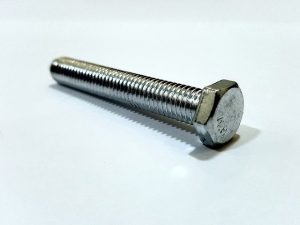
Bolts are mechanical fasteners used to secure two or more objects together. They typically feature three main sections: a head, a shank and an end.
The head facilitates tightening and loosening via a particular drive method. Some bolts have a hex head that allows them to be tightened and loosened using a hex socket or wrench. Other bolts have a Phillips or slotted head, which allows them to be tightened and loosened using a Phillips head or flathead screwdriver, respectively.
What Are Threaded Rods?
Threaded rods are mechanical fasteners used to secure, anchor and brace objects. As their name suggests, they feature a cylindrical rod-like shape with threads. Threaded rods are inserted into pre-drilled holes, at which point they will grip the surrounding material.
Differences Between Bolts and Threaded Rods
Only bolts have a head. Threaded rods are essentially headless bolts. They consist of a shaft with exterior threads, but unlike bolts, they don’t have a head.
Without a head, threaded rods offer a dual-sided fastening system. They are often used in conjunction with nuts. Nuts, of course, can’t be installed on a head. Threaded rods don’t have a head, so they support nuts on both ends.
Threaded rods also have a fully threaded shaft, whereas bolts may have a fully or partially threaded shaft. A fully threaded shaft helps to support nuts. If threaded rods were partially threaded and “smooth” near a given end, you wouldn’t be able to twist a nut onto that end. Some bolts, though, are only partially threaded because it improves their resistance to shear forces.
Another key difference between bolts and threaded rods is that the latter can be easily cut to size. If a threaded rod is too long for a particular project, you can cut it. Both sides are the same, with complete threading and no head on either end. Bolts, on the other hand, are manufactured with precise measurements.
In Conclusion
Bolts and threaded rods aren’t the same. Bolts feature a head and are commonly used to fasten components together at a specific point. In comparison, threaded rods are headless and fully threaded. And with this design, threaded rods support nuts on both ends and can be cut to size.