
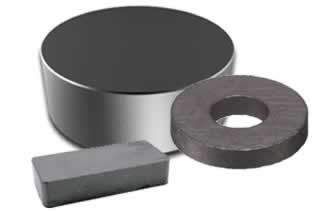
Ceramic and alnico are two of the most common types of permanent magnets. Like all permanent magnets, they constantly produce a magnetic field without relying on an external power source. While you can find them in many of the same shapes and styles, though, ceramic and alnico are two different types of permanent magnets with their own unique qualities.
What Are Ceramic Magnets?
Ceramic magnets are characterized by a ceramic construction. They are made of ceramic compounds. Ceramic magnets are also known as ferrite magnets because the materials from which they are made belong to the ferrite family of magnetic materials.
Ceramic magnets are typically produced by mixing iron oxide with one or more other ceramic materials, such as strontium carbonate or barium carbonate. Once mixed, manufacturers shape the material using a mold, followed by heating it via sintering.
What Are Alnico Magnets?
Alnico magnets are permanent magnets consisting of an alloy made of aluminum, nickel and cobalt. They are known as alnico magnets due to the atomic symbols of these materials (Al, Ni, Co).
Alnico magnets still contain iron, and certain grades may contain additional elements like copper and titanium. Regardless, the three primary alloying elements in all alnico magnets are aluminum, nickel and cobalt.
Differences Between Ceramic and Alnico Magnets
Alnico magnets are typically more heat resistant than their ceramic counterparts. Some grades can withstand temperatures of up to 900 degrees Fahrenheit. With their heat-resistant properties, alnico magnets are commonly used in electrical motors, industrial equipment and other applications where high temperatures are a concern.
Another difference between ceramic and alnico magnets is electrical conductivity. Alnico magnets are electrically conductive, whereas ceramic magnets are not. Instead, ceramic magnets act as an electrical insulator.
Ceramic magnets have the upper hand in terms of demagnetization. They exhibit high coercivity, allowing them to withstand strong opposing magnetic fields without losing their magnetic strength. Alnico magnets exhibit lower coercivity. When exposed to an opposing magnetic field, they will lose more of their magnetic strength.
Finally, ceramic magnets are generally better protected from corrosion than alnico magnets. They feature a ferrite composition that doesn’t rust or corrode like plain iron or steel. This means ceramic magnets can be used without the need for a protective outer coating. With that said, many alnico magnets are resistant to corrosion as well, but they require a specific alloying composition or an outer coating.