
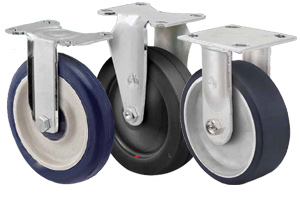
You can’t ignore the wheel material when choosing a caster. Casters, of course, consist of a wheel and mounting frame. They are installed on the bottom of objects to facilitate a rolling mechanism. Once installed, you can roll the objects by pushing or pulling them. You can find casters in different wheel materials, however, including nylon and polyurethane.
What Are Nylon Casters?
Nylon casters are characterized by a synthetic polymer construction. The wheel is made from nylon, which is a family of synthetic polymers. In addition to casters, nylon is used in a wide range of industrial and consumer products. It offers excellent strength, hardness, durability and wear resistance.
What Are Polyurethane Casters?
Polyurethane casters are also characterized by a synthetic polymer construction, but they are made of a different type of polymer. The term “polyurethane” refers to a broad group of synthetic polymers that are joined together with carbamate links. This means manufacturers can create custom formulas with specific properties.
Differences Between Nylon and Polyurethane Casters
One of the biggest differences between nylon and polyurethane casters is hardness. Nylon is a harder and more rigid material. Polyurethane, on the other hand, is typically softer.
Because they are harder, nylon casters are better at resisting compression. They can handle heavy objects and loads without deforming. Polyurethane casters will often compress slightly under the same weight.
Polyurethane casters offer better impact and shock absorption. Because they compress, they are able to absorb more shock. This means polyurethane casters roll smoothly and quietly while simultaneously protecting the floors on which they are used from damage.
Another difference between nylon and polyurethane casters is rolling resistance. Nylon casters generally provide less rolling resistance, especially when used on hard floors and surfaces. Polyurethane casters experience more compression under loads, which manifests in the form of increased rolling resistance.
It’s important to note that some casters feature dual-material wheels. Their wheels aren’t made of a single material. Instead, they feature an inner core material and outer tread material. Regardless, polyurethane and nylon are common wheel materials for casters.
In Conclusion
Neither nylon nor polyurethane casters are better than the other. Each material offers unique properties. Nylon casters are harder, more rigid and better suited for heavy loads and applications. Polyurethane casters provide greater shock absorption, quieter operation and better floor protection.