
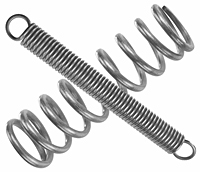
Mechanical springs are used in a wide range of applications. You can find compression-style springs in automotive suspension systems, mattresses, medical equipment and heavy machinery. And you can find extension-style springs in garage doors, trampolines, appliances and medical devices.
Whether compression- or extension-style, all springs are designed to operate under load. They act as energy storing devices. When exposed to a load, they will store energy while exerting an opposite and equal force. Springs, however, can be exposed to different types of loads.
What Is Static Loading?
Static loading is the application of a constant force to a spring. The force is applied gradually until it reaches a specific pressure level. Upon reaching this pressure load, the force remains constant.
Springs exposed to static loading typically experience little or no movement. They don’t become noticeably shorter or longer. Instead, they remain in position as the force acting on them stays the same. Springs only move or change in size once the load is removed.
What Is Dynamic Loading?
Dynamic loading is the application of a changing or “dynamic” force to a spring. It’s characterized by varying pressure levels. With dynamic loading, the pressure to which the spring is exposed changes. The pressure may increase, or it may decrease.
Springs exposed to dynamic loading experience greater movement. Movement, of course, is directly attributed to pressure changes. When the pressure level changes, the spring will move. The greater the pressure change, the more the spring will move. Dynamic loading involves fluctuating pressure levels, so it causes springs to move.
Differences Between Static and Dynamic Loading
Static and dynamic loading aren’t the same. Static loading involves a constant force, whereas dynamic loading involves a variable, changing force.
Dynamic loading is more physically taxing on springs than static loading. It exposes them to more cycles. A cycle involves a spring extending or compressing and then reverting back to its original size. Mechanical springs are designed to handle a finite number of cycles. While many of them can handle thousands or even hundreds of thousands of cycles, dynamic loading may shorten their lifespan.
Different applications involve different types of loads. Static loading involves stationary applications where the equipment doesn’t produce or expose the spring to different pressure levels. Dynamic loading, on the other hand, involves moving applications, such as machinery and vehicles, where the spring is exposed to different pressure levels.