
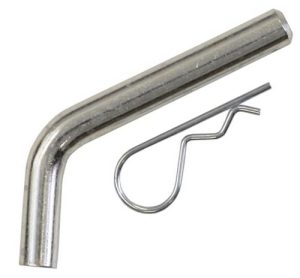
Bent hitch pins offer a simple and effective fastening mechanism. Consisting of a long “bent” piece of solid material, they are used in conjunction with a clip or cotter pin to temporarily secure parts in place. Trailers, for instance, are often secured to towing vehicles with a bent hitch pin and a clip or cotter pin. Below are five facts about bent hitch pins.
#1) The Bend Functions as a Handle
You can identify bent hitch pins by their prominent bend. They aren’t straight. Rather, bent hitch pins have a characteristic bend. This bend isn’t for looks. It functions as a handle, allowing you to pull or push the bent hitch pin through axles or other shafts.
#2) Features a Hole Opposite of the Handle
When inspecting a bent hitch pin, you may notice they have a small hole in them. The hole is located opposite of the handle — near the very end. It’s designed to support a clip or cotter pin. As previously mentioned, bent hitch pins are used in conjunction with a clip or cotter pin. The clip or cotter pin holds the bent hitch pin in place.
#3) No Tools Required
Bent hitch pins don’t require any tools to install or remove. You can install a bent hitch pin by sliding it through a hole in a part like an axle or shaft. Once in place, you can then place a clip or cotter pin through the hole in the bent hitch pin. Removing a bent hitch pin is just as easy as installing it. Simply pull the clip or cotter pin out of the bent hitch pin. You can then pull the bent hitch pin out of the axle or shaft.
#4) Available in Different Finishes
While most bent hitch pins are made of a heavy-duty alloy like steel, they are available in different finishes. Some of them have a zinc finish, whereas others have a vinyl finish. What’s the purpose of a finish exactly? Finishes such as zinc and vinyl are designed to protect bent hitch pins from corrosion. Since they are commonly used outdoors and in humid environments, bent hitch pins are frequently exposed to moisture. Zinc and vinyl finishes, however, shield the pin’s underlying metal from moisture, thereby protecting them from corrosion.
#5) Resists Shear Loads
Bent hitch pins are designed to resist shear loads, which are classified as forces that apply side-to-side pressure. Towing trailers or other equipment often results in shear loads. Bent hitch pins can withstand these forces. This is in stark contrast to traditional fasteners, such as bolts, which are designed for tension loads.