
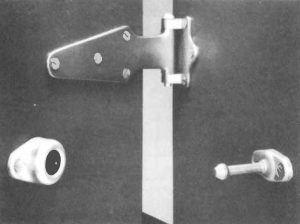
If you’re tired of using random objects to prop open doors, you should consider installing a door holder. As their name suggests, they are designed specifically to hold open doors.
Most door holders consist of two parts. One part is mounted to the door itself, whereas the other part is mounted to an adjacent wall or surface. After opening the door, you can connect the two parts together so that the door stays open. Here are six things to consider when choosing a door holder.
#1) Style
Door holders are available in different styles. Common styles include plunger, T-type and link-type. Plunger door holders feature a plunger part that snaps into a receptacle. T-type door holders feature a T-shaped arm that connects to a receptacle. Link-type door holders feature a linkage component. They are all used to hold open doors, but they feature different parts and work in different ways.
#2) Open Clearance
How much open clearance does the door holder provide? Open clearance is a measurement of how far you can open the door with the door holder engaged. Some door holders, such as plunger-style holders, offer less open clearance than others. If the plunger is particularly long, you may not be able to open the door completely.
#3) Strength
For heavy doors, you’ll need to choose a strong door holder. Exterior doors often weigh more than their interior counterparts. As a result, they require strong and heavy-duty door holders. If a door holder has a thin receptacle or latching arm, it may fail to adequately hold the door shut.
#4) Material
Door holders are available in different materials. Some are made of stainless steel. Stainless steel is an iron alloy with a chromium content of 10.5% or higher. The presence of chromium helps to protect the iron content from oxidation, which could otherwise lead to rust and corrosion. Other door holders are made of zinc-plated steel. They feature a thin outer layer of zinc. This zinc layer serves as a protective barrier.
#5) Noise Level
You should consider the noise level when choosing a door holder. Most door holders produce at least some noise. When the plunger or latch connects to the receptacle, for instance, you may hear a clicking or popping sound. The good news is that some door holders, such as silent door holders, are designed to minimize noise.
#6) Mounting Requirements
Don’t forget to consider the mounting requirements when choosing a door holder. Most door holders require screws to install. You’ll need to drive screws through the components and into the door as well as the adjacent wall or surface. However, the size and number of screws needed varies depending on the door holder.