
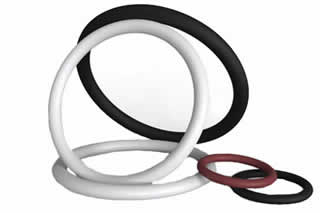
Oil seals play an important role in engines, hydraulic systems, pumps, gearboxes and machinery. They are designed to prevent lubricants or other oils from leaking out of parts while also preventing dirt and debris from entering parts.
Shafts, for instance, often feature an oil seal. Without this otherwise simple mechanical seal, oil will likely leak out, leaving the shaft susceptible to friction-related wear and tear. Whether you’re planning to use it on a shaft or any other part, however, there are several things you should consider when choosing an oil seal.
Diameter
Oil seals are available in different sizes. By considering the diameter, you can choose an oil seal that fits perfectly around the part with which you intend to use it.
Keep in mind that most oil seals have an inner diameter and outer diameter. The inner diameter represents the width from the inner edge of an oil seal to the inner edge on the opposite side. The outer diameter represents the width from the outer edge of an oil to the outer edge on the opposite side. Therefore, the outer diameter will always be wider than the inner diameter.
Material
You should consider the material when choosing an oil seal. Oil seals must be able to withstand regular exposure to fluids, which may be accompanied with heat and pressure. If a seal is made of weak or low-quality materials, it may fail to create a tight seal. Fortunately, you can find oil seals in many effective and high-quality materials, such as FKM, silicone, polyacrylate and Nitrile Buna-N 70 durometer compound.
FKM is a type of fluorocarbon-based fluoroelastomer that boasts one of the widest temperature ranges and chemical resistance. Silicone is an elastic synthetic material consisting of silicon, oxygen, carbon and hydrogen. Polyacrylate is a type of highly durable polymer consisting of acrylic acid. Finally, Nitrile Buna-N 70 durometer compound is a versatile and effective seal material that’s compatible with many other materials.
Temperature Range
Don’t forget the temperature range when choosing an oil seal. Different types of seals have different temperature ranges. Some of them can handle higher temperatures than others, making them ideal for applications involving a lot of heat.
As previously mentioned, FKM seals have one of the widest temperature ranges. They can typically handle temperatures as low as minus 40 degrees Fahrenheit and as high as 400 degrees Fahrenheit. Silicone seals also have a wide temperature range of minus 90 degrees Fahrenheit to 340 degrees Fahrenheit. Polyacrylate seals have a slightly narrower temperature range of minus 30 degrees Fahrenheit to 300 degrees Fahrenheit, followed by Nitrile Buna-N 70 durometer compound at minus 65 Fahrenheit to 250 degrees Fahrenheit.