
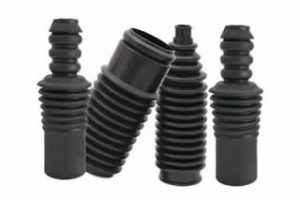
Molding is a common manufacturing process used to make rubber parts. It involves the use of a hollow and rigid frame known as a mold. Manufacturing companies fill these molds with raw rubber to create new parts. Here are six facts about molded rubber.
#1) There Are Different Types of Molding Processes
Not all molding processes are the same. There’s injection molding, compression molding and transfer molding, each of which uses a different set of steps to create rubber parts. With injection molding, liquified rubber is forced into a closed mold. As the rubber cools, it will solidify while simultaneously taking the shape of the mold. With compression molding, rubber is placed directly into a heated mold. With transfer molding, preheated rubber is forced into a closed mold via pressurized runners.
#2) Highly Customizable
Molded rubber is highly customizable. It allows for custom shapes, sizes, hardness and even colors. To create rubber products in a specific shape and size, manufacturers just need to create a matching mold. To create rubber products in a specific hardness level or color, manufacturers can mix additives into the raw rubber. Regardless, molded rubber allows for an unparalleled level of customizable.
#3) Supports Many Types of Rubber
Molded rubber isn’t limited to plain, natural rubber. Molding processes support many types of rubber, including various synthetic rubbers. Each type of rubber has its own unique characteristics.
Common types of rubber used in molding processes include the following:
- Nitrile
- Fluorocarbon
- Fluorosilicone
- SBR
- Polyacrylate
- Neoprene
- Polyurethane
- Ethylene Propylene
- Silicone
- And more
#4) Not the Same as Vulcanized Rubber
Molded rubber isn’t the same as vulcanized rubber. Molded rubber, by definition, is any type of rubber part or product that’s made using a mold (hence the name). Vulcanized rubber, on the other hand, specifically involves the use of heat and pressure, as well as a mold, to enhance the physical properties of rubber. Vulcanized rubber has permanent cross-links, which makes it strong yet also elastic.
#5) Cost-Effective
Many manufacturers use molding processes to create rubber parts because it’s cost-effective. The biggest hurdle is typically mold creation. After the mold has been made, though, it can last for thousands of cycles. Manufacturers can continue using the mold to make new rubber parts during this time. Furthermore, scrap rates are typically lower with molding processes compared to other manufacturing and fabrication processes.
#6) Used to Make a Wide Range of Products
Molded rubber is used to make a wide range of everyday products. Weatherstripping for doors and windows, for instance, is often made of molded rubber. O-rings and gaskets for engines and machines are also made of molded rubber. Even automotive components like brakes and seals are often made of molded rubber.