
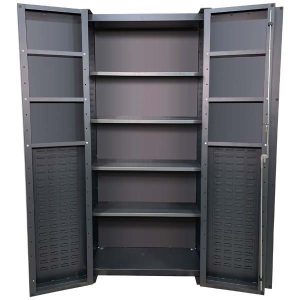
A material handling cabinet is a smart investment for nearly all businesses. They typically feature a spacious interior and a heavy-duty construction. Regardless of your business’s industry, you can likely use a material handling cabinet to organize and store items. When choosing a material handling cabinet, however, you should pay close attention to the door type.
Flush
Some material handling cabinets feature flush doors. They offer a sleek finish that many business owners and professionals prefer. Flush doors are designed to sit flush against the front of the cabinet. They don’t protrude out of the cabinet. Instead, they lie flat to create a smooth, sleek finish. At the same time, flush doors reduce the risk of snagging. There are no protruding surfaces on which to snag clothing or items.
Deep
You can find material handling cabinets with deep doors. Deep doors are thicker than standard doors. They extend deeper into the cabinet than their standard counterpart. Because they are so thick, deep doors do more than just cover the front of the cabinet; they offer additional storage. Many doors contain shelves, bins or other components that increase the cabinet’s total storage capacity.
Louvered
Another common door style for material handling cabinets is louvered. Louvered doors are characterized by a grid-like arrangement of horizontal slats. Known as “louvers,” these slats increase airflow. They allow air to flow into and out of the cabinet. If you’re worried about moisture or humidity accumulating inside of the cabinet, louvered doors offer a solution thanks to their ability to improve airflow.
No Doors
Not all material handling cabinets have doors. Some of them are designed door-less. Without doors, they allow workers to quickly store and retrieve items. You don’t have to worry about opening and closing them. Rather, cabinets without doors are always open.
Choosing the Right Door Type
The right door type depends largely on the work environment and the type of materials being stored. Flush doors are a popular choice for businesses that want a clean, streamlined appearance while also reducing the risk of snagging on protruding surfaces. Deep doors are ideal for facilities that need additional storage capacity because the thicker door design often includes built-in shelves, bins or compartments. Louvered doors, on the other hand, are commonly used in environments where airflow is important. Their horizontal slats allow air to circulate through the cabinet, helping reduce moisture and humidity buildup inside.