
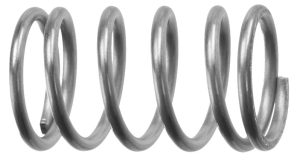
Compression springs are used in many consumer and commercial applications. You can find them in mattresses, sofas, door locks, keyboards, suspension systems, seats, medical devices and more.
As their name suggests, compression springs are designed to “compress” under load. When an external force pushes against one or both ends, they will become shorter. Not all coils in compression springs are the same, however. Depending on the end configuration, many compression springs feature two different types of coils: active and inactive.
What Are Active Coils?
Active coils are those that deflect under load. In other words, they physically deform. When exposed to an external force, the active coils in compression springs twist and flex. This deformation process allows compression springs to store mechanical energy while simultaneously exerting their own reactive force.
What Are Inactive Coils?
Inactive coils are those that remain stationary and unchanged under load. Also known as dead coils, they do not deflect or deform under load. Instead, inactive coils retain their original size and shape.
Differences Between Active and Inactive Coils
Compression springs are comprised of coils, which are the individual loops of wound wire. Some of these coils are active, though, whereas others are inactive.
Only active coils deflect under load. Deflection, of course, is what allows compression springs to store mechanical energy. The compressed active coils store mechanical energy from the load to which the spring is exposed. Inactive coils don’t deflect, so they don’t play a role in energy storage. Instead, inactive coils are used for stability and seating purposes.
You’ll typically find inactive coils at the ends of compression springs. If a compression spring has closed or closed and ground ends, it will likely feature inactive coils at the ends. These coils are wound so tightly that they touch the adjacent coils, resulting in little or no coil pitch (the distance between two coils).
Active coils, on the other hand, are found in the middle of compression springs. All compression springs have active coils, but not all compression springs have inactive coils. As previously mentioned, inactive coils are typically found in compression springs with certain end configurations like closed or closed and ground ends.
In Conclusion
Active and inactive coils each serve a different purpose in a compression spring. Active coils are responsible for the spring’s actual movement, allowing it to compress, store energy and push back against a load. Inactive coils don’t contribute to deflection but till play an important role. They help the spring sit properly and remain stable during use.