
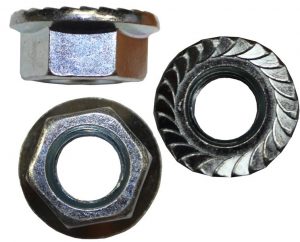
Nuts can loosen when exposed to vibrations. The vibrations from engines or machines, for instance, can cause nuts to loosen from the bolts on which they are installed. Fortunately, locknuts are designed to resist vibrations. When choosing a locknut, though, you should consider the material from which it’s made. Some locknuts are made of metal, whereas others are made of nylon.
The Basics of Locknuts
Locknuts are threaded fasteners that are designed to “lock” in place. Like all nuts, they feature interior threads that allow them to connect to the exterior threads of a bolt. After running a bolt through a set of parts, you can twist a nut onto the end of it so that the bolt doesn’t fall out. While traditional nuts can loosen when exposed to vibrations, however, locknuts are designed specifically to resist vibrations.
What Are Metal Locknuts?
Metal locknuts are characterized by an all-metal construction. They are typically made of high-carbon steel, stainless steel or brass. You can find them in different styles, such as serrated flange, castellated and external tooth. Regardless, metal locknuts are made entirely of metal.
What Are Nylon Locknuts?
Nylon locknuts are characterized by a nylon collar. They still contain metal, such as steel or brass, but they feature a nylon collar as well. Also known as nylon insert locknuts, nylon locknuts feature a ring of nylon around the top. When tightened, this nylon collar deforms around the bolt’s threads to create friction.
Key Differences Between Metal and Nylon Locknuts
Metal and nylon locknuts aren’t the same. Metal locknuts are made entirely of metal, whereas nylon locknuts are made of metal and nylon. Aside from the materials used in their construction, though, there are other nuances between metal and nylon locknuts.
Metal locknuts use a different locking mechanism than nylon locknuts. They typically have deformed serrations or threads that create friction. Nylon locknuts, on the other hand, rely on a nylon collar. The nylon collar will deform when the but is twisted onto the end of a bolt, thereby creating friction that resists vibrations.
Metal locknuts are better suited for high-temperature applications. They can typically withstand temperatures of over 500 degrees Fahrenheit. Nylon locknuts have a lower temperature range of about 250 degrees Fahrenheit. Exceeding this range may damage the nylon collar.
Another difference between metal and nylon locknuts is reusability. While both types of locknuts can be reused, metal locknuts have a longer lifespan. They can withstand many cycles of tightening and loosening, whereas nylon locknuts may need to be replaced after just a few cycles.