
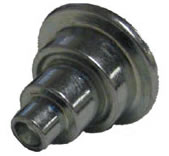
Rivets offer a reliable and long-lasting fastening solution. Consisting of a head and shank, they are used to create permanent joints. You can secure two or more parts together by running a rivet through them. After deforming the tail, the rivet will create a permanent joint that holds the parts together. Rather than using a standard rivet, however, you may want to use a double shoulder rivet.
What Are Double Shoulder Rivets?
Double shoulder rivets are mechanical fasteners with two distinct steps or “shoulders.” Like all rivets, they feature a head and shank. Only double shoulder rivets, though, feature two shoulders. The top shoulder has a larger diameter, and the bottom shoulder has a smaller diameter.
There are also single shoulder rivets. Known simply as “shoulder rivets,” they are characterized by a single shoulder below the head. Double shoulder rivets go one step further by integrating a second shoulder into their design.
How Double Shoulder Rivets Work
Double shoulder rivets are deformed during installation to create permanent joints. They are inserted into predrilled holes. A tool is then used to deform the tail of the shank.
Why do double shoulder rivets have two shoulders exactly? The top shoulder acts as the main bearing surface. It supports the joint’s load while allowing for spacing between the fastened parts. The bottom shoulder, on the other hand, acts as a separate contact surface. It helps to guide alignment while also distributing forces across a larger area.
Why Use Double Shoulder Rivets
With their two-shoulder design, double shoulder rivets offer several key advantages, one of which is better load distribution. Fastening parts creates mechanical stress. If all of this stress is concentrated in a small area, the parts may suffer from fatigue or deformation. Double shoulder rivets protect parts from problems such as this by distributing loads across a larger area.
Another reason to use double shoulder rivets is better alignment. The bottom shoulder acts as a guide. It helps to keep the fastened parts positioned during operation. Even if an assembly has moving parts, the bottom shoulder will ensure proper alignment.
In Conclusion
Standard rivets work well for static joints. For applications involving movement or precise spacing, though, you may want to use shoulder rivets. They offer better load distribution and alignment than their standard counterparts.