
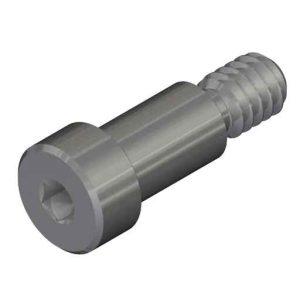
When most people think of screws, they envision traditional threaded fasteners with a pointed tip. There are many different types of screws, however. While most of them feature a pointed tip to cut through materials, others do not.
Precision shoulder screws don’t have a pointed tip. Instead, they have a blunt tip. They are still used to fasten objects together, but they don’t have the same pointed tip as most other types of screws. Keep reading to learn more about precision shoulder screw and how they work.
What Are Precision Shoulder Screws?
Precision shoulder screws are threaded fasteners with a smooth, unthreaded section. Known as a shoulder, this smooth section is located between the head and threaded section. It’s designed with precise dimensions for the diameter and length. The shoulder serves as a guide, making precision shoulder screws ideal for fastening applications that require accurate spacing or alignment.
Common features of precision shoulder screws include the following:
- Blunt tip
- Shoulder (unthreaded section of the shank)
- Tight tolerances
- Circular head with a drive recess
How Precision Shoulder Screws Work
Precision shoulder screws work by functioning as both a traditional threaded fastener and a spacer. Like traditional threaded fasteners, they are designed to hold two or more objects together. When driven into objects, precision shoulder screws will pull and hold the objects together. Unlike traditional threaded fasteners, though, precision shoulder screws are able to create space while simultaneously allowing for controlled movement or alignment.
All precision shoulder screws have a shoulder; that’s essentially what distinguishes them from other types of screws. The shoulder is designed with very tight tolerances — typically within a few thousandths of an inch. These tight tolerances promote a superior level of mating accuracy, ensuring that parts fit properly and with little or no play.
Hex vs Slotted
You can install precision shoulder screws using a tool that matches the drive recess. Some precision shoulder screws have a hex drive recess, whereas others have a slotted drive recess. If it has a hex drive recess, you’ll need to use a hex key. Hex keys are hexagonal, L-shaped tools that fit into hex drive recesses. If a precision shoulder screw has a slotted drive recess, on the other hand, you’ll need to use a flat-head screwdriver.
Reasons to Use Precision Shoulder Screws
Why should you use precision shoulder screws instead of traditional screws? Spacing is one reason. The shoulder serves as a built-in spacer, eliminating the need for separate spacers or washers.
In addition to serving as a spacer, the shoulder offers a bearing surface. If a part needs to rotate, it can use the shoulder as a bearing surface to reduce friction. The part will be able to rotate around the shoulder, all while remaining fastened by the shoulder screw’s threads.