
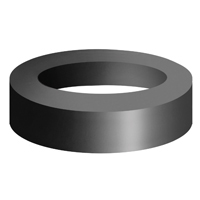
When most people think of magnets, they envision traditional square- or rectangular-shaped permanent magnets. Magnets, however, are available in a wide range of shapes, including ring. Ring magnets produce a magnetic field that allows them to attract ferromagnetic materials, but they feature a unique shape that sets distinguishes them from traditional magnets.
What Are Ring Magnets?
Ring magnets are permanent magnets that feature a ring-like shape. They have a solid, circular outer body and a hollow interior. Some people assume the hole in the center of ring magnets is used for mounting. While it can be used for mounting, the hole actually changes their magnetic field. It essentially creates a balanced magnetic field that wraps around the ring magnet.
Common uses for ring magnets include the following:
- Electric motors
- Speakers
- Automotive components
- Microphones
- Encoders
- Sensors
- Bearings and couplings
- Laboratory instruments
How Ring Magnets Work
Ring magnets work by producing a magnetic field. Most ring magnets are ceramic magnets. Like other ceramic magnets, they are made by mixing iron oxide with strontium or barium carbonate. When heating, these materials fuse together while simultaneously aligning their magnetic domains — a process known as sintering.
All magnets have a north and south pole. The north pole of a magnet, of course, will attract the south pole of other magnets and vice versa. With ring magnets, though, the poles may be located across the face, along the circumference or even on the inner and outer edges.
Benefits of Ring Magnets
Ring magnets offer several benefits, one of which is a uniform magnetic field. Rather than being focused in the center, the magnetic field wraps all the way around them. This makes ring magnets ideal for applications involving rotating or oscillating parts.
You can find ring magnets in different sizes. Some of them are small and thin, whereas others are larger and thicker. When shopping for ring magnets, pay close attention to the inner diameter and outer diameter. The inner diameter is the distance from the inside of a ring magnet to the opposite inner side. The outer diameter is the distance from the outside of a ring magnet to the opposite outer side.
Ring magnets may be small, but they are quite powerful. They produce a strong magnetic field with a substantial pulling force. Their small size and strong magnetic field make them a popular choice for applications where space is limited.