
When shopping for fasteners, you may come across jackscrews. They look like ordinary bolts with an attached nut. Jackscrews, however, are able to lift objects while simultaneously creating space. For a better understanding of jackscrews and how they work, keep reading.
Overview of Jackscrews
Jackscrews are mechanical fasteners that convert rotary motion into linear motion. They are available in different styles, one of the most common being male-female standoff.
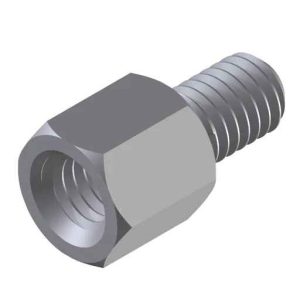
As shown in the photo above, male-female standoff jackscrews feature internal threads and external threads. This dual-thread design allows them to connect to objects with different threads. You can find jackscrews in other styles, but they are all designed to convert rotary motion into linear motion.
How Jackscrews Work
Jackscrews use a simple mechanism of moving up or down depending on the direction in which they are turned. As you turn a jackscrew, it will move through the attached nut. Turning it clockwise will move the jackscrew up or down, and turning it counterclockwise will move the jackscrew in the opposite direction. This otherwise simple process allows jackscrews to lift or apply force to objects.
Some jackscrews have a handle or lever. They still work the same way as other jackscrews, but they offer an ergonomic surface for manual engagement. You can grab the handle or lever and turn it to move the jackscrew up or down.
What Are Jackscrews Made Of?
Jackscrews are available in different materials. Carbon steel is a popular material due to its superior strength. With a high concentration of carbon, it boasts a higher tensile strength than other types of steel.
Stainless steel is a common material in which jackscrews are made. It’s characterized by a chromium content of 10.5% or higher. Like all forms of steel, it’s an iron alloy. Stainless steel, though, has more chromium, resulting in better protection from rust and corrosion.
There are also jackscrews made of hardened steel. During production, they are typically heat-treated to strengthen their threads. Jackscrews made of heat-treated steel are better protected against wear and tear, ensuring they can perform well under repeated stress.
The reliability of a jackscrew is closely tied to the materials used in its construction. If it’s made of metal that is too soft, it will wear out after repeated use. If the material is too brittle, on the other hand, it can break when placed under stress. Engineers choose materials that provide the right mix of strength, resistance to wear and the ability to withstand the surrounding environment.