
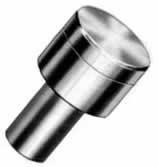
While easy to overlook, rest buttons play an important role in the manufacturing industry. These simple, hardened supports are used to hold parts steady and in the right place. By providing a reliable point of contact, they help keep workpieces aligned during machining or inspection.
The Basics of Rest Buttons
Rest buttons are workholding devices that provide a stable surface on which workpieces can rest. They are placed on tables or inside fixtures to prevent workpieces from shifting. Once mounted, rest buttons will secure the workpiece while allowing for accurate and precise manufacturing processes.
How Rest Buttons Work
As shown in the photo above, rest buttons feature a narrow cylinder section on the bottom and a wider, shorter section on top. The narrow section is the stem, whereas the wide section is the lead.
The stem is inserted into a hole in the table or fixture, thereby leaving the lead exposed. After all the rest buttons have been inserted, the workpiece is positioned on or against the buttons’ leads. The leads will stabilize the workpiece so that it can be worked on without moving.
Rest buttons are used for the following:
- Support workpieces and prevent shifting or sagging
- Locating and positioning workpieces
- Spacing workpieces
Common Features of Rest Buttons
Because they are designed to support and stabilize workpieces, rest buttons are made of strong, hardened materials. Common materials in which rest buttons are made include stainless steel, high-carbon steel and titanium.
You can find rest buttons in different styles, such as push-fit and threaded. Push-fit rest buttons feature a smooth stem, whereas threaded rest buttons feature a threaded stem. Push-fit rest buttons are easier to install and remove, whereas threaded push rest buttons offer a higher level of security and protection from vibrations or other forces.
You can also find rest buttons with different leads. Most of them have flat leads, which allow them to press against a flat part of the workpiece. Other rest buttons, though, have a spherical lead. Spherical leads reduce the contact area, which can help to minimize friction.
In Conclusion
Rest buttons may be small, but their value in manufacturing is significant. By supporting, positioning and spacing workpieces, they make it possible to achieve highly accurate manufacturing processes.