
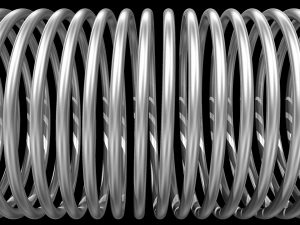
Choosing the right spring is important. Springs, of course, are energy-storing devices. They typically consist of wound coils that, when exposed to an external load, store the load’s energy while simultaneously exerting an equal opposing force. Some springs, however, have a longer free length than others.
Understanding Free Length
Free length represents the total length of a spring in its default, unloaded state. Some springs have a free length of 0.25 inches. Others have a free length of 0.75 inches or longer. Regardless, you can determine a spring’s length in an unloaded state by referring to its free length.
Springs change in length when they are exposed to a load. Compression springs become shorter, whereas extension springs become longer. The free length of a spring is the spring’s length before it’s exposed to a load.
Free Length vs Solid Height
Both free length and solid height are length-based metrics for springs. The difference is that free length represents the spring’s unloaded length, whereas solid height represents the spring’s loaded length.
Solid height is typically used with compression springs only. Compression springs compress when exposed to a load, resulting in a shorter length. Solid height is the total length of a compression spring after it’s exposed to a load and all of its coils are touching with no gaps between.
Why Free Length Matters
You can’t ignore free length when choosing a spring. It’s important for several reasons, one of which is to ensure a proper fit. Springs are often used in products and assemblies with limited space. If a spring is too long in its unloaded state, it may not fit. You can avoid this headache by checking the spring’s free length to ensure it’s the right size for the job.
Free length of a spring will determine its travel. Also known as deflection, travel is the distance a spring moves when exposed to a load. Whether compression or extension, all springs move when exposed to a load. Travel represents how much a spring moves via extending or compressing. It’s heavily influenced by free length. Generally speaking, the longer the free length, the greater the spring’s travel.
Another reason free length is important is because it influences the spring’s force. All springs produce a force when exposed to a load. Springs with a long free length generally produce a greater force than those with a short free length.