
The terms “self-tapping” and “self-drilling” are often used interchangeably when describing screws that cut their own threads. While they share some similarities, however, they aren’t the same. Self-tapping and self-drilling are two different types of screws with their own unique characteristics.
What Are Self-Tapping Screws?
Self-tapping screws are threaded fasteners that cut their own threads. Like all screws, they feature a head, shank and tip. The head may feature a drive recess that supports a bit, such as a Philips head bit, or it may feature a hexagonal shape that supports a socket or wrench. Regardless, self-tapping screws create their own internal threads as they are driven into an object or material.
When you press a self-tapping screw against a pilot hole and turn it with the appropriate tool, the sharp exterior threads on the screw’s shank will create matching interior threads. Thread-forming self-tapping screws displace excess material during this process, whereas standard thread-cutting self-tapping screws physically remove excess material.
What Are Self-Drilling Screws?
Self-drilling screws are threaded fasteners that cut their own threads and drill their own pilot hole. You don’t need to drill a separate pilot hole to install them. Rather, you drive self-drilling screws directly into objects and materials.
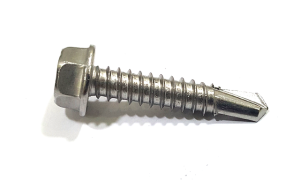
As shown in the photo above, self-drilling screws feature a unique tip with a built-in drill bit. The tip is curved so that it creates a clean pilot hole in objects and materials. With this drill bit-based tip, self-drilling screws eliminate the need for separate drilling.
Differences Between Self-Tapping and Self-Drilling Screws
Self-tapping and self-drilling screws differ in several ways. The main difference is that self-tapping screws require a pilot hole, whereas self-drilling screws do not. They can both cut their own threads, but only self-drilling screws can drill their own pilot hole.
Because they don’t require a pilot hole, self-drilling screws save time. They are essentially a step up from their self-tapping counterparts. They allow for fast and efficient installation. Many workers use self-drilling screws to fasten roofing sheets, HVAC ductwork and framing components for this reason.
You may notice that self-tapping and self-drilling screws have different tips. Self-drilling screws have a drill bit-based tip. Self-tapping screws, on the other hand, have a pointed tip. This pointed tip isn’t capable of creating a clean pilot hole, which is why self-tapping screws require a pilot hole.
Self-tapping screws can offer better precision. By creating a separate pilot hole before installing them, you can ensure the screws have the correct alignment. Self-drilling screws, in comparison, are more likely to become misaligned during installation. These are just a few key differences between self-tapping and self-drilling screws.