
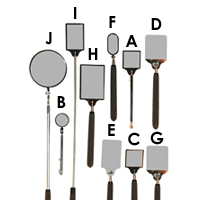
Mirrors aren’t used strictly for decorative purposes; they play an important role in many industries. Workers in the automotive, construction, HVAC, pest control and plumbing industries, for instance, often use inspection mirrors in their daily activities. Like all mirrors, they feature a reflective surface. When light strikes this surface, it bounces off. Inspection mirrors, however, offer a higher level of utility than decorative mirrors.
Overview of Inspection Mirrors
Inspection mirrors are handheld mirrors that are used to view or inspect hard-to-reach places. You can use them to look under vehicles, in ceilings or crawlspaces, behind machinery and more. With their reflective surface, which you can adjust to achieve the perfect viewing angle, inspection mirrors can help you perform a wide range of inspection activities.
Parts of an Inspection Mirror
While there are different types of inspection mirrors, most of them consist of three basic parts: A mirror, a telescoping stem and handle, and a swivel joint. The mirror, of course, is the reflective surface. It’s typically made of glass, stainless steel or acrylic.
The shape of the mirror may also vary. Some inspection mirrors have a rectangular or square mirror, whereas others have a round mirror. You can also find mirrors in different sizes. There are inspection mirrors with small mirrors measuring just 1-1/2 inches in diameter, and there are inspection mirrors with larger mirrors measuring up to 3-1/2 by 2-1/2 inches.
The telescoping stem and handle is the long “arm” to which the mirror is attached. When you aren’t using an inspection mirror, you can collapse the telescoping stem to make it shorter. You can later extend the telescoping stem to make it longer.
The swivel joint is the part of an inspection mirror that allows you to adjust the viewing angle. It’s found where the mirror attaches to the telescoping stem. Most inspection mirrors don’t have a fixed viewing angle. Instead, they have a swivel joint that allows you to change the viewing angle.
Using an Inspection Mirror
Inspection mirrors are simple and easy to use. Regardless of what you are trying to view, you’ll typically want to extend the telescoping stem. Once extended, you should adjust the mirror at the swivel joint. You can then maneuver the inspection mirror so that the angle allows you to view the target object or space. That’s all it takes to use an inspection mirror.