
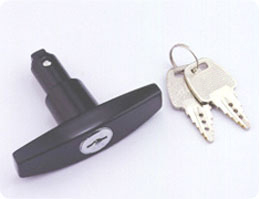
T-handles are prized for their ergonomic design. As their name suggests, they are shaped like the letter T. They feature a vertical pole-like base that transitions into a perpendicular and horizontal gripping surface at the top. With their T-shaped design, T-handles are naturally comfortable and easy to use.
Not all T-handles are the same, however. While they all feature an ergonomic T-shaped design, you can find them in different styles, such as locking T-handles.
The Basics of Locking T-Handles
Locking T-handles are distinguished from other styles of T-handles by their ability to lock. They combine a traditional T-shaped gripping handle with an integrated locking mechanism. This design makes them a convenient access control solution.
Locking T-handles are commonly used to secure the following:
- Doors
- Panels
- Enclosures
- Lockers
- Compartments
- Junction boxes
- Cargo trailers
How Locking T-Handles Work
You can use a locking T-handle by inserting the key and turning it. Most locking T-handles have a keyhole at the top-center of the gripping surface. Upon inserting and turning the key, the internal pins or wafers will disengage, at which point the handle can rotate freely with sufficient force.
Most locking T-handles are cam-based. They feature a latching mechanism in an open or closed position depending on whether the handle is turned. Normally, the latching mechanism will remain closed. Unlocking and turning the handle, though, will shift the latching mechanism to the open position so that you can pull open the door, panel or other surface with which the handle is used.
PAGODA Locking Mechanism
A common feature of high-end locking T-handles is a PAGODA locking mechanism. If you inspect the key, you’ll notice that it’s not completely flat. Rather, it features a three-dimensional profile consisting of three tiers or “steps.” This design reflects the pagoda towers found throughout East and Southeast Asia, which is why it’s called a PAGODA locking mechanism.
With the PAGODA locking mechanism, locking T-handles have hundreds of possible key combinations. Furthermore, the keys are very difficult to duplicate, which further enhances their security.
Another advantage of the PAGODA locking mechanism is that it prevents flat keys from being used. Flat keys won’t fit properly inside of a PAGODA-based keyhole. You’ll need to use a special type of stepped key to engage the internal pins or wafers.