
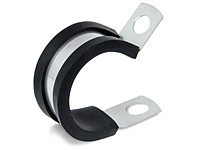
If you regularly work with pipes or tubes, you may want to invest in cushion clamps. They offer a simple and effective way to protect pipes and tubes from damage. Excessive vibrations can result in costly damage. By securing pipes and tubes with cushion clamps, you can minimize vibrations so that damage doesn’t occur.
The Basics of Cushion Clamps
Cushion clamps are two-piece clamping components designed for pipes and tubes. They feature a U-shaped metal core with a padded or “cushioned” inner lining. The metal core provides strength and structure. The inner lining — typically made of a soft material like EPDM, thermoplastic elastomer or vinyl — offers energy absorption and vibration dampening.
Common industries in which cushion clamps are used include the following:
- Aerospace
- Automotive
- Plumbing
- Marine
- Heating, ventilation and cooling (HVAC)
- Construction
- Oil and gas
- Railway maintenance
How Cushion Clamps Work
Excessive vibrations is a leading cause of pipe and tube failure. Research shows that nearly one in five pipework failures is attributed to vibrations. As they vibrate, pipes and tubes will experience concentrated stress at critical areas like joints. Cushion clamps address this problem through energy absorption.
You can install a cushion clamp by placing it over a pipe or tube. Once placed, you’ll need to secure it with a fastener set, such as a bolt and nut. As you tighten the bolt, the cushion clamp will apply gentle pressure to the pipe or tube.
The cushion clamp’s soft lining will absorb energy created via movement. At the same time, it will reduce noise that could otherwise travel through materials or objects adjacent to the pipe or tube. The end result is a longer lifespan for the pipe or tube.
Some cushion clamps also work with strut channels. They feature a fastening mechanism on the bottom that allows them to connect with strut channels. Other cushion clamps have a closed bottom that don’t work with strut channels. Regardless, both types of cushion clamps are used on pipes and tubes.
Cushion Clamps vs Standard Loop Clamps
In addition to cushion clamps, there are standard loop clamps. Loop clamps feature a similar U-shaped design. The difference is that cushion clamps have a padded lining, whereas loop clamps do not.
Without a padded lining, loop clamps are less effective at reducing vibrations. Instead, they are typically used in general and light-duty applications.
In Conclusion
Cushion clamps address the risk of vibration-related damage at its source. Their cushioned lining absorbs movement, reduces noise and prevents metal-to-metal contact. While standard loop clamps work for basic support, they lack the vibration control many applications demand.