
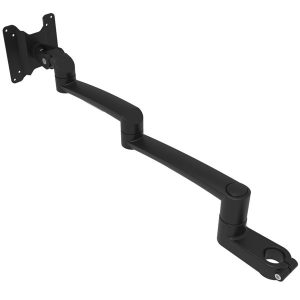
If you regularly work with a computer monitor, you may want to invest in a monitor arm. Also known as a monitor mount or bracket, it can help you create a more ergonomic and productive workspace.
Monitor arms act as a mechanical extension. They are commonly used in hospitals, control rooms, industrial spaces and offices. Once installed, you can use them to adjust the height and angle of a computer monitor. Below are six important things to consider when choosing a monitor arm.
#1) Material
Monitor arms are available in different materials. You can find them in steel, aluminum and even plastic. Steel monitor arms are typically the strongest, whereas plastic monitor arms have the lightest weight. Aluminum monitor arms offer the best balance between strength and weight, making them a popular choice.
#2) Finish
What type of finish does the monitor arm have? Regardless of material, many monitor arms feature a finish to protect against moisture and environmental contaminants. Some of them are painted. Others are powder-coated. Painted and powder-coated monitor arms have a protective outer layer that extends their usable life.
#3) Weight Capacity
Don’t forget to consider the weight capacity when choosing a monitor arm. Plastic monitor arms typically have the lowest weight capacity, with many of them only supporting up to 10 to 20 pounds. Medium- and heavy-duty monitor arms are typically made of steel or aluminum, allowing them to support heavier monitors.
#4) Mount Type
Something else to consider when choosing a monitor arm is the mount type. All monitor arms are designed to hold a computer monitor or electronic display. The way in which they are mounted, however, varies. Some of them are mounted to a pole. Others are mounted to a wall, table or rail system.
#5) Locking vs Non-Locking
Monitor arms are available in locking and non-locking styles. Locking styles are designed to lock the monitor in a fixed position. After adjusting the monitor to the desired position, you can lock it in place. Once locked, the monitor won’t move. Non-locking monitor arms only support adjustments — you can’t use them to lock the monitor in a fixed position.
#6) Motion
Finally, you should consider the motion of a monitor arm. Monitor arms can move in different ways, which affects their adjust monitors. Basic models only allow you to adjust the height of the monitor. More advanced monitor arms, though, offer tilting and swiveling as well.