
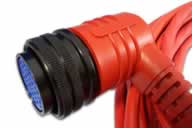
When shopping for cables, you may come across molded cables. They are characterized by a unique manufacturing process that involves molding. A protective material — typically thermoplastic elastomer (TPE) or polyvinyl chloride (PVC) — is heated and then injected into a mold cavity. As it cools, the productive material hardens where the cable joints the connector. With this unique manufacturing process, molded cables offer several key benefits.
Strain Relief
Molded cables offer excellent strain relief. Mechanical stress isn’t isolated to the connector. Instead, molded cables distribute it throughout their body.
Connectors, of course, are often susceptible to mechanical stress. Pulling, twisting or bending a cable may damage the otherwise delicate connection point between the conductor and connector. Molded cables are better protected from such damage because the connector is fused with the cable body.
Built-In Protection
Molded cables don’t require separate, external solutions to protect against common forms of damage. Instead, they incorporate protection directly into their design.
Many cables require heat-shrink tubing or boots for protection. Without these external solutions, their connectors may fail. Molded cables eliminate the need for external solutions by leveraging a molding design.
Electrical Reliability
Molded cables offer excellent electrical reliability. Electrical cables are designed to carry electricity. If the connector becomes damaged, though, it may suffer from performance issues.
Molded cables allow for a stable, long-lasting connection between the connector and the cable conductor. The two parts are integrated into a single unit, making damage less likely to occur. The end result is better electrical reliability.
Withstand Harsh Environment
For applications involving harsh environments, look no further than molded cables. They can handle tough environments without succumbing to damage. Water and moisture, for instance, typically aren’t a concern. Their molded design creates a tight seal at the connector, preventing the intrusion of moisture.
Many molded cables can also withstand contaminants like dirt, solvents, ultraviolet (UV) light and extreme temperatures.
Tamper Resistance
Another benefit of molded cables is tamper resistance. During the molding process, the connector and cable body become fused together. As a result, molded cables are nearly immune to tampering. Other types of cables, in comparison, may feature parts that can be removed.
In Conclusion
The bottom line is that molded cables offer a versatile and effective cable solution. Their integrated design helps reduce mechanical stress, protect against environmental hazards and improve long-term reliability. Hopefully, this will give you a better understanding of molded cables and the benefits they offer.