
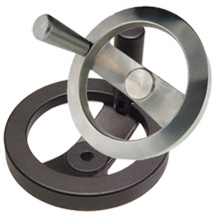
Handwheels are used in a wide range of industrial and commercial applications. With their round shape, they make it easy to adjust machinery. You can open and close valves, move conveyor belts, tighten connections and make other machinery adjustments by turning a handwheel.
While all handwheels feature a round wheel-like shape, they are available in different styles. Some handwheels feature a separate handle, for instance, whereas others use a handle-free design.
What Are Handwheels With a Handle?
Handwheels with a handle are characterized by a perpendicular extension along the outer rim. The handle acts as an alternative gripping surface. Rather than grabbing and turning the rim, you can use the handle.
Common handle types for handwheels include the following:
- Fixed: stationary, upright handle that doesn’t move
- Fold-Away: can be folded down when not in use
- Revolving: features a revolving handle
What Are Handwheels Without Handle?
Handwheels without a handle, on the other hand, lack a perpendicular extension. Instead, they feature a more basic design consisting entirely of a round wheel-like shape. To use them, you’ll need to grab and turn the rim.
Differences Between Handwheels With a Handle and Without a Handle
Both styles of handwheels are ergonomic and easy to use. You can adjust machinery simply by turning them. As you turn the handwheel, it will engage the machinery component to which it’s connected. However, there are some key differences between handwheels with a handle and without a handle.
The presence of a perpendicular handle can increase leverage. It’s positioned along the outer rim, allowing operators to apply more turning force. For high-torque applications, you may want to choose a handwheel with a handle for this reason. For low-torque applications, a handle-free handwheel may suffice.
Handwheels with a handle can also increase operating speed. Some adjustments require many revolutions. If the handwheel has a separate handle, you’ll be able to perform these revolutions faster and more efficiently.
Handwheels without a handle are easier to maintain. They have fewer parts, so they don’t wear out as quickly.
Handwheels without a handle also take up less space. Handles vary in size, with some of them measuring 2 inches long and others measuring 4 inches long. Regardless, the handle extends out from the handwheel itself, so it will consume space. If you’re looking to install a handwheel in a small space, you may want to choose a handle-free model, or you can opt for a handwheel with a fold-away handle.