
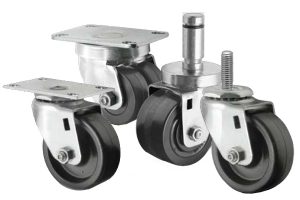
If you’re looking to buy a set of casters, you might be wondering whether wheel brakes are worth it. All casters have a wheel enclosed in or attached to a mountable frame. Once mounted to the bottom of an object, you can roll the object by pushing or pulling it. Some casters, however, are equipped with wheel brakes as well.
The Basics of Wheel Brakes
Wheel brakes are exactly what they sound like: a mechanical feature that prevents a caster’s wheel from rolling. They are available for both stem- and plate-style casters. When activated, brakes lock the caster’s wheel so that it can no longer roll.
How Wheel Brakes Work
Most wheel brakes work via a pedal. You can immobilize the caster’s wheel by pressing down this lever with your foot. The pedal will then engage a brake arm to lock the wheel face. You can disengage the brake arm simply by moving the lever back to its original upright position.
Standard vs Total Lock Wheel Brakes
There are different types of wheel brakes for casters, including standard and total lock. Standard wheel brakes only immobilize the wheel’s forward-backward movement, whereas total lock wheel brakes go one step further by locking both the wheel and swivel section.
All casters can roll forward and backward. Some casters, though, can pivot 360 degrees. Known as swivel casters, they offer a superior level of maneuverability. Swivel casters can feature total lock wheel brakes. When engaged, you won’t be able to roll or turn them. Total wheel brakes are designed to completely immobilize swivel casters by preventing them from rolling and turning.
When to Choose Casters With Wheel Brakes
You may want to choose casters with wheel brakes when moving objects on uneven floor. Failure to immobilize the wheels on uneven floors can result in unintentional rolling. The object may roll down if not secure.
Wheel brakes are particularly useful for heavy loads. A fully loaded material handling cart can weigh hundreds of pounds. If it begins to roll on its own, stopping it can be difficult if not impossible. Wheel brakes improve safety by preventing heavy loads from rolling on their own.
Mobile workstations often feature casters with wheel brakes. Once moved to a new location, workers can immobilize the wheels so that the workstation doesn’t roll or otherwise move on its own. This enhances precision and safety.