
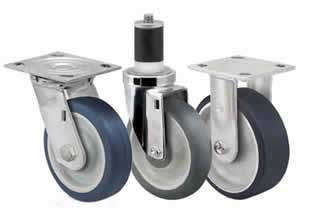
Rubber and polyurethane are two of the most common materials from which caster wheels are made. Rubber is an elastic material consisting of long-chain polymers, whereas polyurethane is a synthetic polymer consisting of carbamate links. So, how do rubber and polyurethane caster wheels differ?
Shock Absorption
Rubber caster wheels offer better shock absorption. They are typically softer than their polyurethane counterparts, which allows them to absorb and dampen vibrations. If you’re looking for casters to use on rough or uneven surfaces, you may want to go with rubber wheels for this reason.
Noise Reduction
Rubber caster wheels excel at reducing noise. They offer a quieter rolling action than polyurethane caster wheels. Noise, of course, is often the result of vibrations. When pushing a cart or object with casters, vibrations will travel through the floor or ground below to create noise. The soft and elastic properties of rubber allow rubber caster wheels to absorb these vibrations and reduce noise.
Durability
While they can both last a long time when properly maintained, polyurethane caster wheels offer a superior level of durability. They provide a tougher and more rugged construction. As a result, polyurethane can withstand harsh conditions without succumbing to abrasion or other forms of physical damage. Many industrial carts, dollies and mobile machinery use polyurethane caster wheels because of their durable construction.
Load Capacity
Another key difference between rubber and polyurethane caster wheels is load capacity. Several factors affect how much weight a caster can safely support, one of the most influential being the wheel material. Casters with polyurethane wheels typically have a higher load capacity than those with rubber wheels. They can handle heavier loads while experiencing less compression.
Chemical Resistance
Many businesses prefer polyurethane caster wheels because of their chemical-resistant properties. They hold up well in otherwise harsh environments — even when exposed to chemicals like oils, solvents or cleaning agents. This is due to the fact that polyurethane is cross-linked on a molecular structure, which allows it to withstand chemicals. Rubber caster wheels, on the other hand, are more susceptible to damage caused by chemicals.
Cost
If you’re on a tight budget, you may want to choose rubber cast wheels. They typically cost less than polyurethane caster wheels. Rubber is a cheaper, more readily available material. Polyurethane, in comparison, is a more complex material that’s more expensive and time-consuming to produce. The end result is a higher price tag for polyurethane caster wheels.