
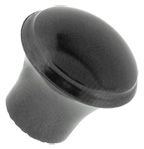
Industrial knobs are available in a variety of styles. In addition to traditional “lobed” knobs, for instance, there are push-pull knobs. Push-pull knobs don’t feature the same star-like shape as their lobed counterparts. Instead, they are typically round with smooth sides. Here’s everything you need to know about push-pull knobs.
What Are Push-Pull Knobs?
Push-pull knobs are industrial knobs that move along a fixed path. Unlike many other types of knobs, they typically don’t rotate. Instead, push-pull knobs are designed for in-out, forward-backward and up-down movement.
Common applications for push-pull knobs include the following:
- Latches
- Airflow systems
- Valves
- Mechanical linkages
- Cable assemblies
- Disconnect systems
- Mechanical locks
- Access panels
- Appliances
- HVAC equipment
Reasons to Use Push-Pull Knobs
Push-pull knobs offer several advantages, one of which is ergonomics. They are designed to be easy to use. You can comfortably grip a push-pull knob with your hand, followed by pulling or pushing it to engage the equipment to which it’s connected.
Push-pull knobs offer natural tactile feedback. In other words, you’ll feel when they engage or disengage. The end result is improved accuracy when using them.
When compared to electronic controls, push-pull knobs have fewer failure points. They aren’t dependent on software, nor do they require power to engage or disengage. These are just a few reasons to use push-pull knobs.
What Are Push-Pull Knobs Made Of?
You can find push-pull knobs in different materials. One of the most common materials used in their construction is phenolic. A type of thermoset plastic, phenolic is a strong and durable material. It can withstand heat, chemicals and mechanical stress.
Some push-pull knobs are made of stainless steel. Stainless steel, of course, is an iron alloy with a chromium content of 10.5% or higher. This chromium acts as a shield to prevent corrosion. When exposed to oxygen, it forms a protective layer so that the underlying iron doesn’t turn to rust.
How Are Push-Pull Knobs Are Mounted?
If you’re planning to use push-pull knobs, you might be wondering how they are mounted. Most require a threaded rod to install. Assuming a push-pull knob is tapped, it will feature interior threading. You can mount it by twisting it onto a threaded rod connected to the machinery or equipment with which you intend to use it.
Other push-pull knobs have exterior threading rather than interior threading. As you may have guessed, they require a threaded hole to install. Whether exterior or interior threading, though, most push-pull knobs are easy to install. Just remember to check the thread sizing to ensure it matches that of the machinery or equipment.