
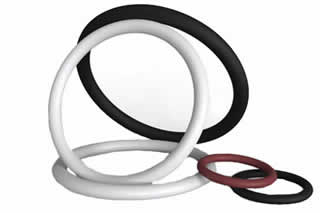
Polyacrylate (ACM) O-rings have become increasingly popular in recent years. Consisting of polymerized ester and a curing monomer, they are used in the automotive and aerospace industries. Like all O-rings, ACM O-rings are designed to contain fluids and gases so that leaks don’t occur. ACM O-rings, however, feature a distinct composition that makes them stand out in several ways.
Chemical Resistance
ACM O-rings offer excellent resistance to chemicals. They can withstand exposure to petroleum-based oils and fuels — all while maintaining a tight seal around shafts or parts. Traditional rubber O-rings, on the other hand, will often swell and degrade, which can compromise their sealing integrity. This makes ACM O-rings very useful for automatic transmissions, gearboxes and hydraulic systems.
Heat Resistance
Another benefit of ACM O-rings is heat resistance. Polyacrylate is often recommended
for high-temperature applications, ranging from minus 30 degrees Fahrenheit to 300 degrees Fahrenheit. Traditional rubber only has a maximum operating temperature of about 180 degrees Fahrenheit, after which it will begin to melt and break down. With their heat-resistant properties, ACM O-rings are often used in engines and transmissions.
UV Resistance
ACM O-rings are also resistant to ultraviolet (UV) light. UV light, such as sunlight, can degrade many materials, including traditional rubber. Polyacrylate, though, can often handle long-term UV exposure without cracking or otherwise degrading. It features a strong, saturated backbone that prevents UV degradation. ACM O-rings can even be made with UV absorbers for an even higher level of UV protection.
Doesn’t Suffer From Compression Set
You don’t have to worry about compression set with ACM O-rings. Compression set is a phenomenon that involves an elastic object, such as an O-ring, succumbing to permanent deformation. O-rings should return to their original shape once the pressure is released. With compression set, they lose their ability to return to their original shape, which can jeopardize their ability to create a tight seal. ACM O-rings have a very low compression set, meaning they maintain their sealing ability for a long time.
Cost-Effective
ACM O-rings are cost-effective. Some types of O-rings offer better chemical resistance, such as those made of fluorocarbon (FKM) or perfluoroelastomer (FFKM), but they typically come at a much higher cost. ACM O-rings are still very durable, but they tend to cost less than their FKM and FFKM counterparts.
In Conclusion
ACM O-rings strike a strong balance between performance and affordability. Their resistance to chemicals, heat, UV exposure and compression set makes them a reliable choice for demanding applications, particularly in the automotive and aerospace industries.