
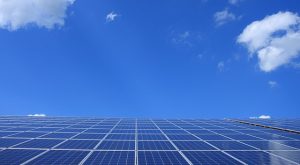
When researching solar panels, you may come across efficiency ratings. Some solar panels have an efficiency rating of just 10%, whereas others boast an efficiency rating of over 20%. You can expect to pay more for highly efficient solar panels, but it’s typically a smart investment that will pay off in the long run.
What Are Solar Panel Efficiency Ratings?
Solar panel efficiency ratings represent how much electricity a panel generates relative to the amount of sunlight it receives. Solar panels are designed to convert sunlight into electricity. When sunlight (photons) strikes the surface of a solar panel, electrons will be released. This creates a flow of current, which can be converted into alternating current (AC) for use in homes and buildings.
Efficient ratings reveal how effectively solar panels convert sunlight into electricity. The higher the efficiency rating, the more electricity the solar panel will produce from the same amount of sunlight. A solar panel with a 20% efficiency rating, for instance, will generally produce twice as much electricity as a solar panel with a 10% efficiency rating.
Common Solar Panel Efficiency Ratings By Cell Type
Efficiency ratings are heavily influenced by cell type. Solar panels are available in different cell types, such as monocrystalline, polycrystalline and thin film. Each type has its own unique design.
Monocrystalline solar panels are made of a single uncut silicon wafer, whereas polycrystalline solar panels are made of multiple silicon crystals that have been melted down. Thin-film solar panels are made of one or more semiconducting layers on a substrate, such as glass.
Of the three major cell types, monocrystalline is the most efficient. They have an average efficiency rating of 18% to 23%. The second-most efficient cell type is polycrystalline with an average efficiency rating of 16% to 18%. While the thinnest and most affordable, thin-film solar panels are the least efficient with an average efficiency rating of 10% to 13%.
Other Factors That Affect Solar Panel Efficiency Ratings
Aside from cell type, there are other factors that can affect a solar panel’s efficiency rating. Temperature, for instance, plays a key role in how much electricity a panel generates. Solar panels actually perform best in cool environments. Excessive heat can reduce their voltage and lower their overall efficiency rating.
Shading is another factor that affects efficiency ratings. Solar panels can still produce electricity in shade, but it will make them less efficient. Even partial shade from a nearby tree or building can lower a panel’s efficiency rating.
Dirt and debris can affect a solar panel’s efficiency rating. Solar panels need to be cleaned regularly. When neglected, dirt and debris will accumulate on the surface, restricting the amount of sunlight reaching them. Most experts recommend cleaning solar panels twice a year for maximum efficiency.