
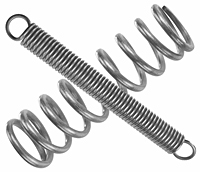
Springs can’t stretch forever. Whether extension or compression, all springs have a point at which they will no longer behave like a spring. Known as the elastic limit, it defines the physical limits of a spring. For a better understanding of the elastic limit of springs, keep reading.
What Is the Elastic Limit?
The elastic limit represents the physical limit of a spring. All springs are designed to store mechanical energy. When exposed to an external force, they will absorb and store mechanical energy. The greater the force, the more mechanical energy they will store. The elastic limit is the maximum force to which a spring can be exposed before the spring becomes permanently deformed.
What Happens When a Spring Exceeds Its Elastic Limit?
Springs change in size when exposed to an external force. Compression springs become shorter, whereas extension springs become longer. Normally, though, they will return to their their original shape after the external force acting on the spring has been removed. If you pull an extension spring, for instance, it will become longer. Releasing the extension spring from your hand will cause it to return to its original size.
If a spring exceeds its elastic limit, it will no longer return to its original size. The spring will succumb to permanent deformation.
Factors That Affect the Elastic Limit
Several factors affect the elastic limit of springs, one of which is the material. Springs are available in different materials, including high-carbon steel, stainless steel, bronze and various alloys. Each material has its own distinct atomic structure that can influence a spring’s resistance to permanent deformation and, thus, its elastic limit.
Whether a spring has been heat treated can affect its elastic limit. Heat treatment typically promotes a more uniform molecular structure. In turn, springs become stronger and able to absorb stress more evenly.
Another factor that can affect the elastic limit of springs is wire thickness. Most springs, including compression and extension, are made of wire. The diameter of this wire will influence a spring’s elastic abilities. Springs made of thick wire can typically handle greater forces and have a higher elastic limit than those made of thinner wire.
Even environmental conditions can affect a spring’s elastic limit. Temperature, for example, plays an important role in elastic limits. Heat will typically soften springs, which can lower their elastic limit. Humidity can also lower a spring’s elastic limit by promoting corrosion, which in turn gradually degrades the spring and negatively affects its elastic limit.