
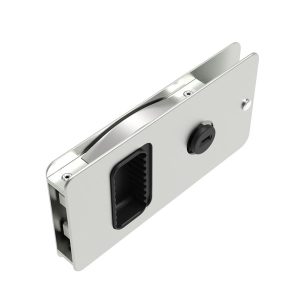
When shopping for latches, you may come across sliding-action latches. Like all latches, they are used to secure doors, cabinets and access panels. Sliding-action latches, however, don’t rotate during use. Instead, they operate via a straight side-to-side movement. To learn more about sliding-action latches, keep reading.
An Introduction to Sliding-Action Latches
Sliding-action latches are mechanical latches that lock into place when pushed horizontally. They don’t have any rotating parts like a cam. While there are different styles of sliding-action latches, they all live up to their namesake by leveraging a sliding action.
Common materials in which sliding-latches are made include:
- Zinc alloy
- Aluminum
- Stainless steel
- Carbon steel
- Reinforced plastic
How Sliding-Action Latches Work
You can use a sliding-action latch by pushing the door or object on which it’s installed to the side. Sliding-action latches typically have two main parts: a moving element and a fixed element. The moving element — a bolt, pawl or bar — is installed on the door or object that moves. The fixed element — a stroke plate or keeper — is installed on the adjacent frame that remains stationary.
When you push the door or object to the side, the moving element will travel along a guided path. It will eventually reach and engage with the fixed element to create a secure hold. Pulling the door or object in the opposite direction will disengage the moving element from the fixed element, thereby opening the door or object.
Why Use Sliding-Action Latches
Sliding-action latches offer several advantages over traditional rotary latches, one of which is a hands-free operation. You don’t need to manually engage them. Most sliding-action latches automatically lock into place when the moving element reaches the fixed element.
Sliding-action latches are long-lasting. Rotary latches require leverage, which introduces uneven stress. Over time. This stress can degrade their parts while shortening the latch’s lifespan. Sliding-action latches distribute forces more evenly along the horizontal path of travel, resulting in less localized wear.
Another reason to use sliding-action latches is a clean finish. Many sliding-action latches are designed to sit flush or nearly flush with the door or object on which they are installed. They don’t create large protrusions. Instead, they offer a clean finish that many people prefer.
Because they offer a clean finish, sliding-action latches are often safer than protruding latches. Protruding latches have surfaces that can snag clothing or tools. In commercial environments, this creates a risk of bodily injury. Sliding-action latches reduce the risk of injury by removing protruding surfaces and offering a clean finish.