
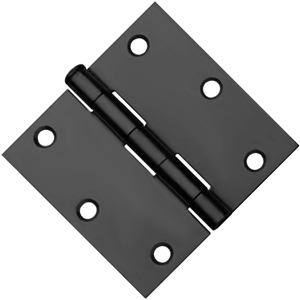
Doors rely on hinges to open and close properly. While available in different styles, all door hinges function as mechanical bearings. They feature two leafs and a knuckle. The knuckle rotates to allow for a limited angle of rotation. Below are five common mistakes to avoid when installing door hinges.
#1) Ignoring Door Weight
You should consider the weight of the door when installing a set of door hinges. Some doors are heavier than others. Exterior doors, for instance, can weigh over 100 pounds, whereas interior doors typically weigh just 30 to 50 pounds. You should choose a set of hinges that can safely support the weight of the door.
#2) Mortising Too Deep or Too Shallow
Most door hinges are mortised so that the leafs sit flush with the door and frame. However, you should avoid mortising them too deep or too shallow. If the mortise is too deep, the hinge’s leafs will sink into the door and frame, which can lead to binding. If the mortise is too shallow, the hinge will protrude out of the door and frame, resulting in a large gap. You can avoid problems such as these by mortising to a depth of about 1/8 inch.
#3) Installing on Outside of Exterior Doors
Don’t make the mistake of installing hinges on the outside of exterior doors. Exterior doors need to be secure. If a set of hinges are installed on the outside of an exterior door — meaning the knuckle is visible on the outside — it can pose a security issue. Burglars or other nefarious individuals may remove the door by knocking the pins out of the knuckle. You can prevent this from happening by either using security hinges or installing the hinges on the inside of exterior doors.
#4) Using the Wrong Screws
Another common mistake to avoid when installing door hinges is using the wrong screws. Most door hinges have six screw holes — three on each leaf. If a screw is too large, it may not fit through these holes. If a screw is too small, conversely, it may fit loosely while allowing the hinge to move freely. Choose a set of screws in the right size, as well as material, for the door with which you intend to use them.
#5) Not Drilling Pilot Holes
Before driving screws through the leafs, you should drill pilot holes into the door and frame. Failure to drill pilot holes can lead to the wood splitting or the screws becoming misaligned. Using a slightly smaller drill bit than that of the screws, create a set of pilot holes where the leafs will sit. You can then safely mount the leafs without splitting the wood.