
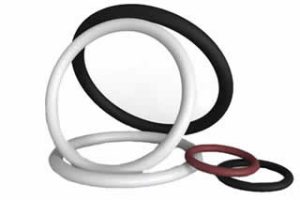
When shopping for O-rings, you may come across the terms “solid core” and “hollow core.” They are used to describe the internal energizer.
All encapsulated O-rings have a component that imparts memory to the seal. Known as an internal energizer or core, it plays an important role in an O-ring’s ability to protect against leaks. While some O-rings have a solid core, others have a hollow core. Here’s everything you need to know about solid core and hollow core O-rings.
What Are Solid Core O-Rings?
Solid core O-rings are circular, ring-shaped mechanical seals with a solid internal energizer. They still have an open center, resulting in a ring-like shape. Solid core O-rings, however, feature an inner ring that’s solid. This inner ring — the internal energizer or core — is typically made of fluoroelastomer (FPM) or silicone.
What Are Hollow Core O-Rings?
Hollow core O-rings, on the other hand, are circular, ring-shaped mechanical seals with a hollow core. From the outside, they look like their solid core counterparts. Hollow core O-rings simply have a hollow internal core rather than a solid core.
Differences Between Solid Core and Hollow Core O-Rings
Encapsulated O-rings can be categorized as solid core or hollow core depending on their construction. Most fall under the category of solid core. They feature a solid internal energizer, which is typically made of a highly elastic material like FPM or silicone. Some encapsulated O-rings, though, feature a hollow core.
For high-pressure applications, solid core O-rings are often preferred. They can handle higher pounds per square inch (PSI) than hollow core O-rings.
Solid core O-rings also feature a simpler design than their hollow core counterparts. They are typically made of a single material, such as nitrile or silicone. Hollow core O-rings, in comparison, are made of multiple materials: one material for the outer jacket and another material for the internal energizer or core.
There are still reasons to choose hollow core O-rings. For starters, they have lower compression requirements. In other words, they require less pressure to compress, making them ideal for low-pressure sealing applications. Even low PSI can cause hollow core O-rings to compress and, thus, deal the surrounding space.
Hollow core O-rings provide excellent surface conformity. Even if the surface with which they are used isn’t completely flat and smooth, they can provide a tight seal. The hollow design allows them to seal minor surface imperfections better than solid core O-rings.