
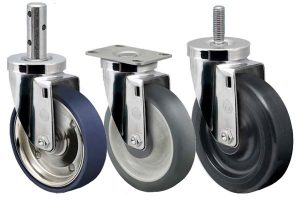
When installing casters, you might be wondering if you can mix rigid and swivel casters. There are two primary types of casters: rigid and swivel. Rigid casters are characterized by a fixed direction of mobility, meaning they can only roll forward and backward. Swivel casters, on the other hand, can swivel in a complete 360-degree angle, allowing them to roll in all directions.
When to Use All Rigid Casters
You may want to use all rigid casters when dealing with heavy loads. They may offer less mobility, but rigid casters are stronger than their swivel counterparts. As a result, they typically have a higher load capacity
Rigid casters also require less maintenance than swivel casters. Since they only roll forward and backward, they don’t require ball bearings or other complex parts. And without these parts, rigid casters require less maintenance.
When to Use All Swivel Casters
You may want to use all swivel casters when working in tight spaces. Swivel casters offer an unparalleled level of mobility. With their 360-degree rotational movement, they make it easy to roll objects in tight spaces.
Hospitals and medical facilities, for instance, often use swivel casters for extra mobility. Many hospitals and medical facilities have narrow hallways. With swivel casters, practitioners and nurses can easily move equipment through these narrow hallways.
Yes, You Can Mix Rigid and Swivel Casters
You don’t have to limit yourself to only using rigid or swivel casters on an object; you can mix them. Mixing involves the use of both types of casters on the same object.
There are different configurations available when mixing rigid and swivel casters. One option is to install two swivel casters at the front of the object and two rigid casters at the rear. With the swivel casters up front, you can still easily turn and maneuver the object. The rigid casters, however, improve the object’s ability to roll in a straight line for long distances.
Another configuration is to install rigid and swivel casters in a diamond shape. This involves a single swivel caster at the front of the object, a single swivel caster at the rear, and one rigid caster on each side of the object. The diamond configuration is very maneuverable but lacks the stability of other configurations.
For heavy loads that require mobility, you may want to use four swivel casters and two rigid casters. This involves two swivel casters at the front of the object and two swivel casters at the rear, as well as a single rigid caster on each side of the object. The rigid casters on the sides essentially support the load and reduce the weight on the front and rear swivel casters.