
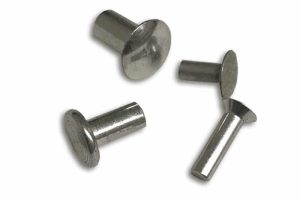
When fastening objects with rivets, you may want to use rivet caps. Rivet caps are decorative cap-like covers designed for use with rivets. Rather than leaving the head of a rivet exposed, you can cover it with a rivet cap. Doing so will create a more finished appearance while also covering the rivet’s sharp edges. Below are five things to consider when choosing a rivet cap.
#1) Material
Like the rivets with which they are used, rivet caps are available in different materials. Common materials include stainless steel, aluminum and brass. Stainless steel rivet caps offer excellent protection from corrosion, making them ideal for harsh environments. Aluminum rivet caps offer a lightweight and cost-effective solution. Brass rivet caps stand out for their appearance. They feature a polished, decorative appearance.
#2) Finish
Rivet caps are available in different finishes as well. Finishes consist of an outer layer of material or coating — separate from the main material from which the rivet cap is made. Zinc and nickel are popular finishes for rivet caps. Zinc is typically a more-effective option, but it supports different colors like black. Nickel, on the other hand, offers a harder texture and a more naturally shiny appearance.
#3) Head Diameter
You should consider the head diameter when choosing a rivet cap. Rivet caps work by snapping over the top of rivets. Not all rivets are the same size, however. Some of them are large and bulky, while others are smaller and more compact. Therefore, you must choose a rivet cap in a size that matches the rivet. If a rivet cap is too big or small, it won’t fit. You can avoid sizing problems such as this by checking the head diameter to ensure it matches the rivet.
#4) Body Diameter
In addition to the head diameter, you should consider the body diameter when choosing a rivet cap. Rivet caps, of course, don’t actually have a body. Instead, they consist of basic snap-on caps. The body diameter represents the diameter of the shank or body of the rivet with which the cap should be used. A rivet cap with a body diameter of 1/8 inch, for example, should be used with rivets with a 1/8-inch body.
#5) Split vs Tubular
Some rivet caps are designed for split rivets, whereas others are designed for tubular rivets. Split and tubular rivets are both permanent fasteners that offer a high level of protection against vibration-related loosening. Tubular rivets, through, feature a partially hollow shank. Split rivets, in comparison, feature a solid shank that’s split in the center.