
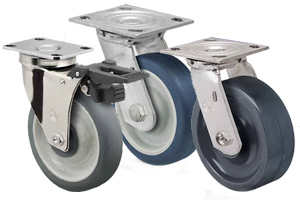
Swivel casters offer an unparalleled level of maneuverability when compared to rigid casters. They aren’t limited to forward and backward movement. Whether kingpin or kingpinless, all swivel casters can turn in a complete 360-degree angle. Some swivel casters, however, have a longer swivel lead than others.
What Is Swivel Lead?
Swivel lead is the distance between the centermost point of a caster’s swivel bearing and the wheel axle. For swivel casters, the wheel axle and swivel bearing typically aren’t perfectly aligned. Instead, the wheel axle is farther back. Swivel lead is a measurement of just how far back the wheel axle is relative to the swivel bearing above it.
The longer the swivel lead, the farther the wheel axle is from the caster bearing. Some casters have a swivel lead of 2 inches, whereas others have a swivel lead of a half-inch or less. Even a short swivel lead, though, can have a big impact on a caster’s performance.
The Impact of a Long Swivel Lead
Casters with a long swivel lead roll more smoothly than those with a short swivel lead. The greater offset allows the wheel to trail the swivel axle more naturally. The end result is less resistance and smoother rolling.
A long swivel lead reduces the risk of caster flutter. Caster flutter is a phenomenon in which a swivel caster’s wheel oscillates or “flutters” from side to side. When you push a cart or object forward, the casters should follow this same path by rolling forward as well. Caster flutter means the affected caster or casters will rapidly oscillate from side to side.
The Impact of a Short Swivel Lead
Casters with a short swivel lead often provide tighter turning. You can turn them more easily in tight spaces, making them ideal for buildings with narrow hallways.
Casters with a short swivel lead can also handle heavier loads. If there’s too much distance between a caster’s swivel bearing and wheel axle, it may sustain damage under heavy loads. The long swivel lead will expose the caster to stress. You can avoid this problem by choosing a caster with a short or more moderate swivel lead.
In Conclusion
Casters with a swivel lead essentially have an offset design. The wheel isn’t directly below the swivel bearing. Rather, it’s offset, which is measured by the caster’s swivel lead. Swivel lead influences how smoothly a caster rolls, how easily it turns and how much weight it can safely carry.