
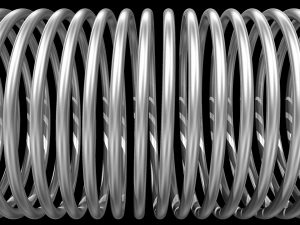
Compression springs are characterized by their ability to shorten or “compress” under a load. They are typically made of spring steel or stainless steel wound in the shape of a coil. When exposed to an external force, the coils will move closer together, resulting in a shorter length. While some compression springs use a constant-rate design, however, others use a variable-rate design.
What Is a Constant-Rate Compression Spring?
A constant-rate compression spring is a type of compression spring that reacts with a uniform and consistent pushing force. It still becomes shorter under a load. As a constant-rate becomes shorter, is coils will compress at a uniform rate will simultaneously exerting a pushing force. Constant-rate compression springs offer a simple and reliable mechanism for storing mechanical energy.
What Is a Variable-Rate Compression Spring?
A variable-rate compression spring is a type of compression spring that reacts with a nonuniform and inconsistent pushing force. When exposed to a load, it may initially feel loose while compressing and shortening by a significant amount. As the load continues to press against it, though, the variable-rate compression spring will become stiffer. They are known as “variable-rate” springs because their rate of compression is dynamic and changes non-linearly.
Differences Between Constant-Rate and Variable-Rate Compression Springs
Constant-rate and variable-rate compression springs are designed differently. They both have coils, but the spacing of their respective coils varies.
The coils on a constant-rate compression spring are spaced evenly apart. The distance between a compression spring’s coils is often referred to as the pitch or wire diameter. With constant-rate compression springs, the pitch or wire diameter for all coils is the same.
The coils on a variable-rate compression spring, on the other hand, are not spaced evenly apart. Instead, they are tapered. Some of the coils will be spaced farther apart from each other than the other coils. This unique design results in different pitches or wire diameters.
Variable-rate compression springs react differently to loads than constant-rate compression springs. As previously mentioned, constant-rate springs always compress at a uniform rate, but variable-rate springs compress at different rates due to the uneven spacing of their coils.
Most types of compression springs use a constant-rate design. They are more versatile and can be used in a wide variety of applications. Variable-rate compression springs, in comparison, are typically used in specialized applications, such as suspension systems for automobiles and heavy equipment.