
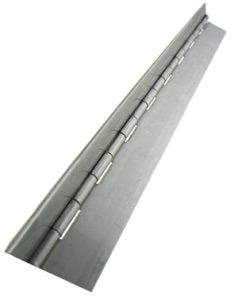
You can’t ignore the pin diameter when shopping for hinges. With the exception of specialized hinges, such as living hinges, most hinges have a pin. It consists of a long cylindrical rod that holds the two leafs together to form the knuckle. You can essentially disassemble a hinge by removing the pin.
While most hinges have a pin, however, some of them have a thicker pin than others. Pin diameter represents the thickness of a hinge’s pin. Hinges with thick pins have a greater pin diameter than those with thin pins.
The Correlation Between Pin Diameter and Hinge Strength
The diameter of a hinge’s pin will affect its overall strength. A thick pin typically results in a stronger hinge. To better understand the correlation between pin diameter and hinge strength, you must familiarize yourself with the basic mechanics of a hinge.
Hinges feature two leafs, each of which is mounted to an object or surface (e.g. door and frame). Once mounted, hinges allow for a limited angle of rotation. You can pull open a door or cabinet, for example. The pin is responsible for holding the two leafs together. With a thick pin, hinges can hold more weight. They can handle heavier doors, cabinets and other objects.
Protection From Bending and Buckling
If you’re worried about bending or buckling, you should choose a hinge with a thick pin. Hinges with thick pins are better protected from bending and buckling than those with thin pins.
A larger cross-section allows hinges to resist bending forces more effectively. A smaller cross-section, on the other hand, makes hinges more susceptible to bending forces. A hinge with a thin pin may fail to support a heavy door or cabinet. When you pull open a heavy door or cabinet, the hinge may bend or buckle. Deformation typically starts small but can grow over time, leading to problems such as misalignment or binding.
Better Weight Distribution
Not only are they stronger, but hinges with thick pins offer better weight distribution than those with thin pins. As previously mentioned, hinges support the objects on which they are mounted. If you mount a hinge on a door, it will support the door when pulled open. If you mount a hinge on a gate, it will support the gate when pulled open. A thick pin will distribute the weight of the supported object across a larger area. With that said, if the pin is too thick, it may make the hinge stiff.