
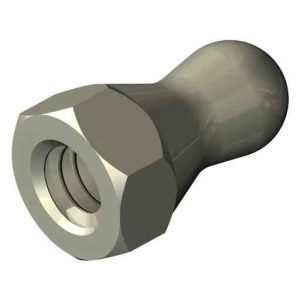
When shopping for mechanical fasteners, you may come across ball studs. They are characterized by a dome-shaped head. While available in different styles (see below), all ball studs feature a threaded section and a dome or “ball” section. This unique design makes them a popular choice for use in applications requiring repeated engagement and disengagement.
What Are Ball Studs?
Ball studs are spring-based fasteners that are used to join two or more objects with articulation. They feature a dome-shaped head and a threaded body. The ball acts as a pivot point, allowing an attached clip to rotate.
Ball studs are used in conjunction with a spring clip. Known as “speed clips,” they support varied levels of tension. You can increase or decrease a ball stud’s tension by adjusting the speed clip. At the same time, speed clips allow for angular movement, which is a key advantage of ball studs over traditional fasteners. Articulating joints like those created with ball studs protect parts from friction-related damage, resulting in a longer lifespan and less maintenance.
Ball studs are commonly used in the following applications:
- Electronics
- Enclosures
- Gas springs and dampers
- Access panels
- Service doors
- Heating, ventilation and cooling (HVAC) systems
- Strut mounts
- Appliances
- Furniture
Male vs Female Ball Studs
Ball studs are available in two primary styles: male and female. They both feature a dome-shaped head and a threaded section, and they are both used to secure objects while allowing for articulation. The difference lies in their threaded section.
Male ball studs have exterior threads. The threaded section essentially consists of a narrow shank with exterior threads. Female ball studs, on the other hand, have interior threads. The threaded section consists of a hole with exterior threads running throughout.
With their exterior threads, male ball studs are used in holes. You can install a male ball stud by placing it in a pre-cut hole, followed by securing it with a nut on the opposite side. Female ball studs, in comparison, access a threaded fastener, such as a bolt.
What Are Ball Studs Made Of?
Ball studs are available in different materials. Many of them are made of stainless steel. Stainless steel ball studs are strong, durable and perform well in humid environments, such as the outdoors. There are also plastic and composite ball studs. They are lightweight and inexpensive but lack the strength and durability of their steel counterparts.
You can also find ball studs in different finishes. Zinc is a popular finish in which they are made. A layer of zinc is applied to the surface of ball studs to enhance their corrosion-resistant properties.