
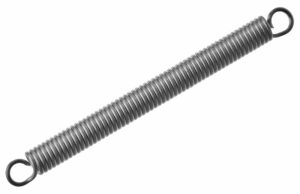
Closed-wound springs offer a reliable and versatile form of energy storage. Like all springs, they are designed to store mechanical energy. When exposed to a load, they will become shorter or longer while simultaneously storing the load’s energy. Closed-wound springs, however, feature a unique design that distinguishes them from other types of springs.
Overview of Closed-Wound Springs
Not to be confused with closed-end springs, closed-wound springs are characterized by little or no spacing between the individual coils. All springs have coils. Coils are the helical loops that form a spring’s overall shape and structure. Most springs are made of a single piece of material — typically metal like spring steel or aluminum — with many coils.
Closed-wound springs feature coils that touch each other. There’s little or no spacing between the coils. Instead, the coils are wound tightly together so that they touch each other. You can find closed-wound springs in different materials, sizes and types (see below). Regardless, they all have very tight coil spacing.
Common Types of Closed-Wound Springs
Extension springs are a common type of closed-wound springs. Also known as tension springs, extension springs become longer when exposed to a load. They are used in applications where the load pulls the spring from one or both sides. This pulling action stretches the spring so that it becomes longer. When not exposed to a load, though, extension springs typically have little or no spacing between their coils.
Another common type of closed-wound springs is torsion. Torsion springs store mechanical energy by twisting around an axis. They apply a twisting force as the angle of rotation changes. The coils in torsion springs touch each other, so they are classified as closed-wound springs.
Why Choose Closed-Wound Springs
With their tightly wound coils, closed-wound springs offer several advantages. For starters, they are compact. Closed-wound springs take up less space than other types of springs. As a result, they are a popular choice for furniture, machinery and other applications where limited space is a concern.
Closed-wound springs are efficient. They store, as well as release, mechanical energy with little waste. With other types of springs, the large spacing between the coils allows for wasted energy. Closed-wound springs have little or no coil spacing, which makes them more efficient at storing and releasing energy.