
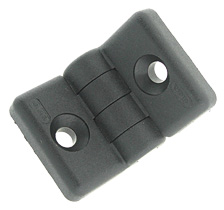
Hinges play an important role in many everyday objects. You can find them on doors, gates, cabinets, access panels, toolboxes, lids, medicine bottles, furniture and more.
Hinges allow parts to rotate and swing open from an adjacent part. They typically feature two leafs and a knuckle. One leaf is mounted to one part, and the other leaf is mounted to the adjacent part.
What Are Torque Hinges?
Torque hinges are specialized hinges that produce resistance after being opened to a specific angle. Also known as friction or positioning hinges, they don’t rotate freely like traditional hinges. Instead, they resist movement after rotating to the predetermined angle.
Torque hinges receive their namesake from the amount of rotational force required to move them, which is torque. Manufacturers typically specify their torque in inch-pounds, or in some cases, newton-meters.
Many lids use torque hinges. If you’ve ever lifted a lid halfway, only for it to remain open without falling and closing, chances are it was installed with torque hinges. With traditional hinges, gravity would pull the lid back down. Torque hinges, on the other hand, create resistance to hold the lid open.
How Torque Hinges Work
Torque hinges work by leveraging a friction element to create resistance. When a torque hinge rotates, certain parts will press against each other. This pressing action creates friction that holds the hinge open.
There are many different styles of torque hinges. Constant torque hinges, for instance, provide uniform resistance through their range of motion, whereas adjustable torque hinges allow users to increase or decrease the resistance level. There are also two-way torque hinges that, as the name suggests, create resistance during both opening and closing. Regardless, they all work by creating resistance.
Benefits of Torque Hinges
Torque hinges offer several benefits, one of which is improved safety. Heavy doors and objects can fall. If your hand happens to be in the way, you could sustain an injury. Torque hinges minimize the risk of such hinges by automatically holding doors and objects open.
Another benefit of torque hinges is improved productivity. They are commonly used in workspaces because they eliminate the need for workers to hold open certain objects. Workers don’t need to hold open objects installed with torque hinges, allowing them to use both hands on other tasks.
Torque hinges last a very long time. Like all mechanical bearings, hinges can wear down from repeated use. Torque hinges, though, have a long lifespan due to their natural slowing function. They prevent doors and objects from slamming shut, which minimizes unnecessary wear and tear to extend the object’s service life.