
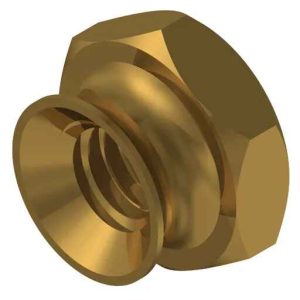
Nuts are commonly used to secure the ends of threaded fasteners. When joining two or more parts with a bolt, for instance, you may want to use a nut. You can drive the bolt through the parts, after which you can twist a nut onto the end of the bolt. The nut will create a clamping force that holds the parts together and prevents the bolt from coming out.
There are different types of nuts, however. While most of them require a wrench or socket to install, thumb nuts do not. Here’s everything you need to know about thumb nuts.
What Are Thumb Nuts?
Thumb nuts are fasteners that require finger-tightening. You don’t need any special tools to install or remove them. Rather, you can tighten or loosen them using your fingers.
How Thumb Nuts Work
Thumb nuts work like most other nuts by securing the end of a threaded fastener and holding two or more objects in place. They feature internal threads that connect to the external threads of a bolt or similar threaded fastener.
You can install a thumb nut by placing it over the exposed end of a bolt. Using your fingers, grab and rotate the thumb nut clockwise until you achieve the desired tightness.
Benefits of Thumb Nuts
Why should you use a thumb nut instead of a traditional nut exactly? One of the main benefits of these alternative fasteners is their tool-free operation. While traditional nuts require a wrench or sockets to install, thumb nuts require nothing more than your fingers.
Another benefit of thumb nuts is protection from over-torquing. Over-torquing involves the application of too much rotational force when installing a fastener. If you use a wrench or socket, you may accidentally apply too much force, resulting in damage to the fastener or the parts with which it’s used. Thumb nuts eliminate the risk of over-torquing by requiring finger-tightening.
Common Types of Thumb Nuts
You can find thumb nuts in different styles. Some of them are round and smooth, for instance, whereas others are knurled. They both require finger-tightening to install, but knurled thumb nuts have a textured surface. With their textured surface, knurled thumb nuts are typically easier to grip. Smooth thumb nuts, on the other hand, feature a cleaner and more visually appealing finish.
In Conclusion
Thumb nuts offer a practical alternative to traditional nuts. Their tool-free design makes them easy to install and remove while also reducing the risk of damage from over-torquing. With options like smooth or knurled styles, they provide flexibility for different needs and preferences.