
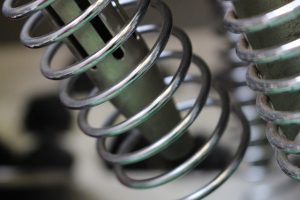
Springs are mechanical devices that store, as well as release, energy. The most common type, coil springs, consist of a single piece of coiled metal. When exposed to a load, coil springs will store the energy will simultaneously exerting their own equal reactive force. Elastic fatigue, however, can hinder a coil spring’s performance.
What Is Elastic Fatigue?
Elastic fatigue is a stress-induced phenomenon that involves a coil spring — or any material or object for that matter — to weaken and lose its ability to return to its original shape.
Coil springs are designed to deform under a load, meaning their shape changes. Compression-style coil springs become shorter under a load, whereas extension-style coil springs become longer. When the load is released, they will return to their original shape. Elastic fatigue is characterized by a spring’s inability to return to its original shape. Instead, the coil spring will remain compressed or extended, depending on the style.
Exceeding the Elastic Limit
All coil springs have an elastic limit. It’s the maximum length a spring can be compressed or extended before permanent deformation occurs. Exceeding a spring’s elastic limit will result in structural damage that manifests in the form of elastic fatigue.
Poor Materials
Coil springs are available in a variety of materials, some of which are better protected from elastic fatigue than others. Springs made of stiff or rigid materials, for instance, are more susceptible to elastic fatigue than those made with highly flexible materials. A properly treated alloy, such as 302 stainless steel, offers an excellent combination of strength, ductility and flexibility.
Corrosion
Corrosion can cause elastic fatigue. Coil springs are typically made of metal. When exposed to moisture, salt or certain chemicals, they can corrode. Corrosion involves the gradual degradation of a material through environmental contaminants such as these. Over time, it can weaken coil springs and make them more susceptible to elastic fatigue. Fortunately, many coil springs are treated with a protective finish to minimize the risk of corrosion.
Repeated Loading and Unloading
The repeated loading and unloading of a coil spring can cause elastic fatigue. Every time a coil spring flexes, its atoms will shift. The constant shifting of a spring’s atoms can cause micro-sized cracks to form. Eventually, these cracks can grow and merge, resulting in elastic fatigue. This is why it’s important to choose high-quality coil springs for applications involving repeated loading and unloading. Many high-quality springs can handle 10,000 to 100,000 cycles of loading and unloading.