
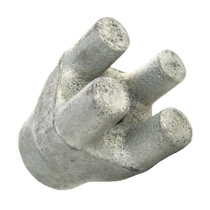
Industrial knobs come in a variety of styles. Lobed knobs, for instance, are characterized by a star shape with five or six points, whereas instrument knobs are small and cylindrical. A lesser-known style, however, is bar. Bar knobs are commonly used in clamping and adjustment applications, but they feature a unique design that sets them apart from other knob styles.
Overview of Bar Knobs
Bar knobs are industrial knobs with prong-like extensions. They are known as “bar knobs” because they can be tightened with a bar. A typical bar knob has four extensions that protrude upward from the corners.
Most bar knobs are made of cast iron. They are made by pouring molten iron — along with about 2% to 4% carbon — into a mold cavity. As the molten iron cools, it will harden while taking the shape of the mold. The casting is then ejected from the mold, resulting in a newly created bar knob.
Benefits of cast-iron bar knobs include the following:
- Strong and durable
- Allows for maximum torque
- Long-lasting
- Offers a clean and modern appearance
- Highly recyclable
How Bar Knobs Work
Bar knobs work by connecting to a threaded stud or hole. When you turn a bar knob, it will engage the machine or object to which it’s connected.
Some bar knobs are studded, whereas others are tapped. Studded bar knobs have a threaded stud at the bottom, which allows them to connect to machines and objects with a threaded hole. Tapped bar knobs, on the other hand, have a threaded hole in the center, which allows them to connect to machines and objects with a threaded stud. Whether studded or tapped, though, turning a bar knob will engage the machine or object to which it’s connected.
Tightening Bar Knobs
Bar knobs can be tightened in one of two ways: by hand or with a bar. Hand-tightening involves grabbing and turning a bar knob by its prong-like extensions. You don’t need any special tools. Just grab some or all of the extensions and turn. Turning the bar knob clockwise will generally tighten it, whereas turning it counterclockwise will loosen it.
Alternatively, you can tighten a bar knob with a bar. If you’re struggling to tighten a bar knob by hand, using a bar may offer a solution. This will allow you to apply more leverage and torque. Simply place the bar between the knob’s extensions and turn it.