
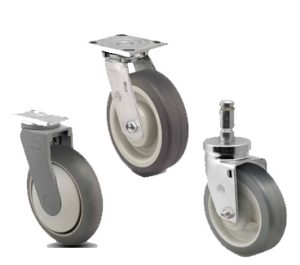
Swivel casters offer a superior level of maneuverability when compared to their rigid counterparts. They are characterized by the presence of a swivel mechanism between the wheel and the mounting stem or plate. While rigid casters can only roll forward and backward, swivel casters can rotate 360 degrees.
Swivel casters, however, may experience rapid, side-to-side oscillation. Known as caster flutter, it can make them difficult to control. When pushing a cart or object with swivel casters, flutter will cause unwanted side-to-side movement. By understanding what causes caster flutter, you can take the necessary steps to prevent it.
#1) Load Imbalance
One of the most common causes of caster flutter is load imbalance. When one caster supports more weight than the other casters, it will experience greater pressure on its bearings and swivel mechanism. The wheel’s center of gravity will shift in response, increasing the risk of caster flutter.
#2) Worn Bearings
Worn bearings can cause caster flutter. Most swivel casters feature a ring of ball bearings to reduce friction. Over time, these bearings can wear out. Worn-out bearings can make the caster more vulnerable to unwanted movement or “play” when rolled, including caster flutter.
#3) Rolling Too Fast
You may notice that caster flutter occurs more frequently at fast speeds. All casters have a speed range in which they are designed to operate. Exceeding the limit of this speed range can change the wheel’s behavior. Rather than rolling forward, for instance, the wheel may oscillate from side to side.
#4) Dirt and Debris
The buildup of dirt and debris can cause caster flutter. When particulate matter such as this goes unchecked, it will create friction and resistance by clogging the caster’s bearings. Furthermore, dirt and debris can harbor moisture that promotes corrosion, which can also clog bearings and contribute to caster flutter.
#5) Extreme Temperatures
Extreme temperatures can cause caster flutter. In excessively hot environments, the tread may soften and deform to the point where the wheel no longer rolls as intended. In excessively cold environments, the tread may harden to the point where the wheel fails to adequately absorb shock.
#6) Improper Mounting
Casters that are mounted improperly may flutter when rolled. If a caster is installed at an angle, for instance, it won’t swivel along the true path. The caster will succumb to lateral forces that make it unstable. All casters need to be aligned and mounted properly to prevent fluttering.