
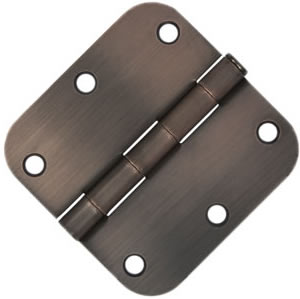
When shopping for door hinges, you may come across the term “hinge radius.” It’s a key specification for rounded door hinges. Some door hinges have a 1/4 inch radius, whereas others have a 5/8 inch radius. To learn more about hinge radius and why it matters, keep reading.
What Is Hinge Radius?
Also known as corner radius, hinge radius represents the curvature of a door hinge’s corners. It provides insight into how rounded off the corners are from a perfect 90-degree angle. A small radius indicates the corners are sharp and more pointed, whereas a large radius indicates the corners are more rounded.
Do All Door Hinges Have a Radius?
Not all door hinges have a radius. Regardless of material or style, most door hinges fall under one of two categories: rounded or square. Rounded door hinges are characterized by rounded corners. Square door hinges are characterized by square corners.
Only rounded door hinges have a radius. Square door hinges essentially have 90-degree corners with a radius of zero. Rounded door hinges, on the other hand, have rounded corners — typically with a radius of either 1/4 inch or 5/8 inch.
Why Hinge Radius Matters
You can ignite hinge radius when shopping for door hinges. Door hinges are typically mortised during installation. They aren’t installed directly on the flat surface of the door and frame. Rather, they are installed in shallow cutouts. A process known as mortising, it allows for a flush finish while simultaneously supporting and stabilizing the hinges.
The cutouts in which door hinges are installed, however, must match the size and shape of the leafs. If a hinge’s leafs are larger than the cutouts, the hinge won’t fit. If the leafs are smaller than the cutouts, it will sit loosely while failing to support and stabilize the hinge.
Hinge radius matters because it defines the shape and size of a hinge’s leafs. When mortising a door hinge, you’ll need to create a cutout in this shape and size.
The radius of a door hinge will also affect its aesthetics. Some people prefer door hinges with sharper corners, such as 1/4 inch, whereas others prefer door hinges with more rounded corners, such as 5/8 inch.
In Conclusion
Understanding hinge radius can make a noticeable difference when installing or replacing door hinges. The radius determines not only how well the hinge fits into a mortised cutout but also how the finished door looks once installed. Whether you choose a 1/4-inch radius for a sharper, modern look or a 5/8-inch radius for a softer, rounded appearance, matching the hinge radius to your door’s existing cutouts ensures a proper fit and smooth function.